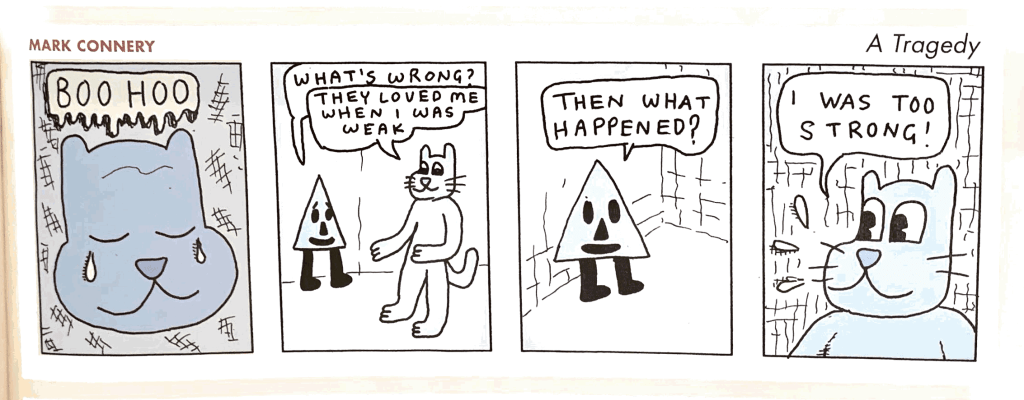
Connery, a Torontonian, has been producing his minis and comics himself, distributing them through the mail or anonymously dropping copies at punk shows, libraries, and on public transit, leaving a portion of his readership up to the vagaries of fate. Very punk indeed.
Alan admits, it’s OK not to read the great works everyday:
But you don’t read Shakespeare every single day and you certainly don’t read the tragedies every single day. Those are incredibly demanding for the same reason you don’t every night sit down and watch an Ingmar Bergman movie or 12 Years of Slave or something like that. You have to be able to give yourself a break from the demands of really great works of art.
Great works of art ask a lot of us and we’re kidding ourselves if we think we can rise to that occasion every single day. So, sometimes you ought to be reading Harry Potter instead of reading Shakespeare because you need a break. And I think both Bloom and Adler were reluctant to acknowledge that.
On seeing where your W-H-I-M takes you:
Yeah. So, I got this from the poet Randall Jarrell, who ended an essay that way, read at Whim. And Whim with capital W, W-H-I-M is a kind of a principle or a policy. Let me tell you how I came onto this. What would happen is that year after year after year, so I’ve been a college university teacher for 35 years now and I would have students who would come to my office and they would say, “I’m about to graduate, but there’s so many great things I haven’t read yet. Give me a list of things to read. Give me a list of books that every educated person should have read.” And they’re coming in with their notebooks and they’ve got their pins poised over the notebook. Like, “Give me these things.”
And I would think you’re just finishing up four years of school, give yourself a break. You don’t have to do this now. You don’t have to read according to an assignment or according to a list of approved texts. Enjoy your freedom. Go out there and follow your whim. And by that, I mean follow that which really draws your spirit and your soul and see where that takes you. If it turns out that you spend a year reading Stephen King novels or something like that, that’s totally fine. That’s not a problem. Read your Stephen King novels, but there are also really good novels.
But whatever it happens to be, if you’re reading young adult fiction for a year, read young adult fiction for a year. After a while, you probably got to have enough of that. But don’t go around making your reading life a kind of means of authenticating yourself as a serious person. It’s just no way to live. So, I would always tell them, “Give yourself a break. Don’t make a list. See where Whim takes you.”
How to read “upstream”:
Well, what happens is that there is a kind of an emergent structure in a way, things emerge. So, here’s one of the things that I will tell people. I’ll say, “Let’s say you really love Tolkien and you’ve read Lord of the Rings like 10 times and you’re not sure you want to read the Lord of the Rings again.” First of all, I will say, “Rereading is always a good idea. It’s always a good idea. But there may be times when you think, yeah, maybe I don’t need an 11th reading of the Lord of the Rings.”
And so, I’ll say, “Well then, let’s move upstream a little bit. Why don’t you ask yourself what did Tolkien read? What did he love? If you love Tolkien’s writing, what writing did Tolkien love and kind of go upstream of him and find out what he read.” And in that way, you’re doing something that is really substantial. I mean, learning about some new things, some important things, things that are really valuable, but you’re also kind of following whatever it is in your spirit that responded to Lord of the Rings. You’re taking it to that next level.
Yeah. So, I’ve done this before, this going upstream, but in a different way. So, my favorite novel of all time, I said this before on the podcast lots of times is Larry McMurtry’s Lonesome Dove.
Alan Jacobs:
Yeah.
Brett McKay:
And then I started reading his like … I’ve read that thing like five times, but then I was like, I’ve got to read the prequels. I started reading like a Dead Man’s Walk and a Comanche Moon. And then I started learning about that. I was like, “These Comanche Indians, I didn’t know about this.” And so, I was like, I went on Amazon and just searched books about Comanche Indians and that’s how I discovered Empire of the Summer Moon, fantastic book. It was some of the best books I’ve read.
Alan Jacobs:
Right. But you wouldn’t have discovered it if you hadn’t been actually reading at Whim. You were not thinking, “Oh, let me see, I’ve read this Larry McMurtry book, now I need to read all the other books that were well-reviewed that year.” Instead you were following up something that was really drawing you on. In a way, you’re just obeying your own curiosity and that’s a much better guide to reading than having a list that somebody else has given you.
And rereading a book can shake your core:
Brett McKay:
Well, what do you think the value of rereading is?
Alan Jacobs:
Well, there’s a lot. I mean, first of all, if it’s a really worthwhile book and books can be worthwhile in a thousand different ways, you’re never going to get everything important out of it on a first reading. But then in addition to that, you go through different stages of life. And in those different stages of life, books speak to you in dramatically different ways.
I remember once I used to teach Tolstoy’s Anna Karenina almost every year. And one year I was reading it and I came across a passage, which totally knocked me out and I couldn’t even remember having read it before. I’d taught the book six or seven times and I had completely passed over this particular passage. And it’s a passage where one of the two protagonists, a man named Konstantin Lëvin, his wife kitty has just given birth to their first child. And he picks up his newborn son and the first thing he thinks is, now the world has so many ways to hurt me. And it’s just an incredibly powerful scene.
Why didn’t I notice it before? Because I hadn’t had children before. It was as soon as my son was born, I saw that passage in a way that it would have been irrelevant to me before because it was so disconnected from my experience. At that point I thought to myself, what’s wrong with you that you didn’t notice this? Did you have to have a child in order to understand how emotionally overwhelming it is to have a child? I guess so. So, I learned something about myself there. I learned about the things that I was paying attention to and not paying attention to.
Read on a W-H-I-M.
Forge your own reading path. You don’t always need someone’s list to guide you.
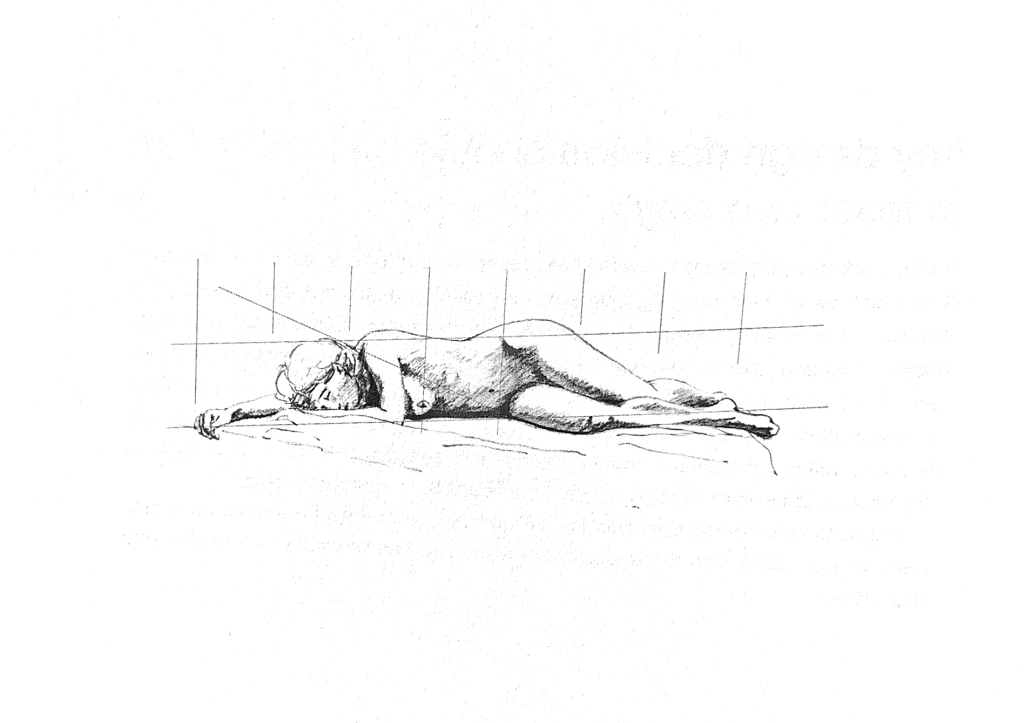
Every drawing you undertake has a hierarchy. There are the general elements. And there are the fine details.
Matthew Frederick recommends laying out the entire drawing to start.
How?
By making use of:
Light guide lines.
Geometric alignments.
Visual gut-checks.
These techniques will help ensure the proportions and placement of shapes are accurate.
After that hit the details. But don’t over indulge in one place:
When you achieve some success at this schematic level, move to the next level of detail. If you find yourself focusing on details in a specific area of the drawing, indulge briefly, then move to other areas of the drawing.
Master questioner (is that a word?) Tim Ferris brings all the good stuff out of Kevin:
When you think of the word or hear the word successful, who’s the first person who comes to mind?
Kevin Kelly: Jesus.
Tim Ferriss: Why would you say that?
Kevin Kelly: There aren’t that many people who’ve left their mark on as many people in the world as he has. I think what hewas up to, what he was doing is vastly been twisted, misunderstood, whatever word you want, but nonetheless, what’s remarkable is … and here’s a guy who didn’t write anything. I think success is also overrated.
Tim Ferriss: I’d love for you to elaborate on that.
Kevin Kelly: Greatness is overrated. I mentioned big numbers, but it’s more of the impact that they had on people’s lives. I think we tend to have an image of success that’s so much been skewed by our current media, just like our sense of beauty of women. In terms of all possibilities, it’s in a very small, narrow, define … ritualistic in a certain sense. I think our idea of success is often today it means you’re somebody who has a lot of money, or who has a lot of fame, or who has some of these other trappings, which we had assigned, but I think can be successful by being true to, and being the most ‘you’ that you could possibly be. I think that what’s I think of as when you think of Jesus, whether you take him as a historical character or anything beyond, was about … He certainly wasn’t imitating anybody, let me put it that way. I think that’s the great temptation that people have is they want to be someone else, which is basically they want to be in someone else’s movie. They want to be the best rock star, and there’s so many of those already that you can only wind up imitating somebody in that slot. I think to me the success is like you make your own slot. You have a new slot that didn’t exist before. I think that’s of course what Jesus and many others were doing, but they were making a new slot. That’s really hard to do, but I think that’s what I chalk up as success is you made a new slot.
Tim Ferriss: What is your new slot? You knew that was coming.
Kevin Kelly: Who says I’m successful?
Tim Ferriss: I’m not. I’m trying to not make any assumptions here. Or what would be your slot?
Kevin Kelly: My slot would be Kevin Kelly. That’s the whole thing. It’s not going to be a career or you would really ideally be something that would … you had no imitators. You would be who you are, and that is success actually in some sense is you didn’t imitate anybody, no one else imitated you afterwards. In a certain sense you have, if you become an adjective, that’s a good sign, right?
Tim Ferriss: Mm-hmm (affirmative).
Kevin Kelly: I think success is actually you make your own path. If they’re calling you a successful entrepreneur, then to me that’s not the best kind of success
Whenever I need an encouraging kick in the ass I listen to this interview.
Kevin isn’t saying that one shouldn’t have ambition. He’s saying that our idea of success – money, possessions, lifestyle, is narrow.
That attempting to live someone else’s life is narrow, foolish even.



 Floodlights and Goalposts