Montaigne loved open debate. “No propositions astonish me, no belief offends me, whatever contrast it offers with my own.” He like being contradicted, as it opened up more interesting conversations and helped him to think–something he preferred to do through interaction rather than staring into the fire like Descartes. His friend Florimond de Raemond described his conversation as “the sweetest and most enriched with graces.” Yet when Montaigne was not feeling sweet, or when he was carried away by the topic of discussion, he could be vociferous. His passion led him to say things that were indiscreet, and he encouraged others to do the same.
Bakewell, Sarah. How to Live: Or A Life of Montaigne in One Question and Twenty Attempts at an Answer. New York: Other Press, 2011 pp170.
Category: amreading
-
-
What if across your lifetime, you could only choose one book to read?
You can only read so many books in a lifetime. I mean, part of me thinks we’d be better off picking one book and never reading another book, and just getting through that one book very well.
The Cultural Tutor. 48:46Which book would you choose?
For readers, it would be challenging to only read one. Dipping in and out of books is proven method for determining what to read. But the idea of rereading for a deeper understanding is invaluable.
See philosopher/entrepreneur Johnathan Bi‘s careful reading approach:
-
Despite setbacks, he kept reading, writing, and cataloging.
Sometimes we don’t even know we’re preparing for our big project. At this point in J.A. Baker’s life he was back in Chelmsford, unemployed. But…
He was not disheartened. As far as he was concerned his real work was going very well: in the three months between returning from Roffey and starting work in London he had read almost sixty books; such ‘aesthetic stimulus’, as he called it, was far more important to his long term goals. Now that he had time on his hands, he was keen to devote it to his literary projects. Days and nights were spent feverishly reading and writing.
He built up his personal library. Something he’d continue to do through his lifetime:
By the end of January 1946, Baker’s library had grown to remarkable levels. Dozens of books of poetry had been consumed as he made his way through the canonical writers of the nineteenth century, including Walt Whitman, Gerard Manley Hopkins and Robert Browning (as well as translations of the French and German poets Rimbaud and Rilke), and moved on to modern writers: John Masefield, T.S. Eliot (whom he had grown to like, despite not having been offered a job at Faber), Cecil Day Lewis and Stephen Spender. He discovered a love for the lilting style of the ‘ultra-modern’ Dylan Thomas, whom he thought perfectly mirrored his own memories of childhood and love of the countryside.
and Baker practiced his writerley scales:
Exercise books were filled with notes on form and metre, and hundreds of poems carefully copied out. Study was an outlet: it helped him to stave off bouts of depression that continued to threaten.
Saunders, Hetty. My House of Sky: The life and work of J.A. Baker. Lower Dairy, Toller Fratrum, Dorset: Little Toller Books, 2017.
-
Shasta cried only a very little; he was used to hard knocks.
Lewis. C.S.. The Horse and His Boy. New York: Harper Collins, 2002.Annie. Jay-Z. C.S. Lewis. The phrase “hard-knocks” has been around since 1870.
-
Baker wasn’t just bird watching
E.M. Nicholson‘s book The Art of Bird Watching recommends keeping a card system to document bird sightings:
Along with the field notes (which, according to Nicholson, had to be made in the field within the first few minutes of the sighting), Nicholson also advised his readers to make another, more detailed and permanent record. This, he said, should be something like a card system, and most certainly, ‘not a record in diary form which’, he remarked, ‘soon becomes unmanageable.’
Baker ignored this. He took up the diary form. Which makes sense considering Baker’s literary tendencies:
Yet a record in diary form was exactly what Baker chose to write when he started his ‘systematic watching’. At the end of each outing he would come home and write up the day’s field notes into the exercise books he kept in the spare bedroom which he had converted into his study. Here he kept other kinds of birding notes that also went beyond Nicholson’s remit of a useful permanent record. Sometimes these included flowers or feathers that he had brought home, often for Doreen but also for himself as tokens of the day’s expedition and inspiration for his writing.
and
He kept cardboard folders, too, for his other natural history research, on the covers of which he wrote lists of suggested contents. One read: ‘Speculations / Introductions / Valley / Topography / Geology / History / Species Occurring / Peregrine in Essex / Essex Generally / Arrival & Choice of Territory … ‘ ‘ Unmanageable’ might have been Nicholson’s description – and perhaps this was just part of Baker’s unmanageable nature – but in any case Baker seemed to manage it quite well.
I have the suspicion Baker enjoyed this ‘unmanageable’ process. All the detail and time it demanded likely helped him absorb the information even deeper.
Discover your own process. What’s unmanageable to some, could be your ideal.
Saunders, Hetty. My House of Sky: The life and work of J.A. Baker. Lower Dairy, Toller Fratrum, Dorset: Little Toller Books, 2017.
-
A poem for the autumnal equinox.
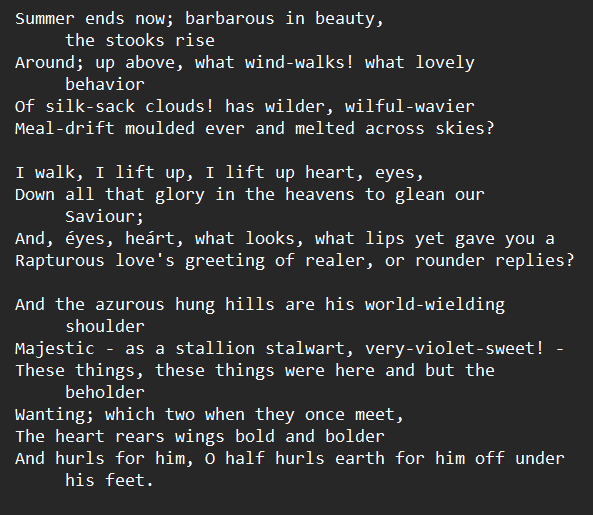
Hopkins, Gerard Manley. Hopkins: Poems (Everyman’s Library Pocket Poets Series) London: Everyman’s Library, 1995.
-
Beer incentivizes science.
From Will O’Brien’s piece in the Fitzwilliam
Taken over its entire history, Guinness may just be the most successful company Ireland has ever produced. In 1930, it was the seventh largest company in Britain or Ireland. It is one of our oldest companies of note. Considering that it predates the Bank of Ireland and the State itself, it could even be said that Guinness is the longest-running successful large institution in Ireland.
Will O’BrienThe Irish brewing company has relentlessly innovated on multiple fronts.
- Workplace benefits
- Annual leave
- Free meals (today would be a company cafeteria)
- Family trips
- Healthcare
- Pension
- Housing!
- The creation of a Guinness Research Laboratory
- The Easy pour system (1959) – Invented by mathematician Michael Ash. Allowed lesser skilled bartenders to serve a quality pour.
- Project ACORN (1969) – Advanced. Cans. of. Rich. Nectar. The first attempt to improve the can or bottle pour.
- “widget” – a gas filled, tennis table sized ball at the bottom of the can that releases a gas that creates bubbles. This greatly improved the taste of home-served pints.
- Branding – Guinness is good for you, Guinness is bad for you, The Guinness Book of Records, producing a Nigerian action film.
Guinness is proof that companies who endure, innovate across multiple areas of their business over an extended timeline. Innovation doesn’t pause.
A must read piece if you’re interested in history, economics, marketing, or beer.
- Workplace benefits
-
Morale is real. Don’t dismiss it.
Brilliant weirdos Alexey Guzey and Brian Timar explain morale. Worth bookmarking this one for discouraging moments. It could help you figure out why your morale is low.
First, ponder this idea:
Morale is your motive force, and you live or die by its maintenance.
Brian Timar & Alexey GuzeyAlexey and Brian go on to share a list of 10 + things that increase and decrease morale.
ThreeFour morale boosters from their list that resonate:11. doing
35. making a decision
3. going outside
13. stopping a thief
Three morale sappers to be wary of:
4. being a coward
5. punting decisions
9. spending time on a task and not feeling closer to finishing it
Consider morale booster #11 – doing. Don’t only read these, go on and create your own list of morale increasers.
Some increasers (sunlight) are perennial, but many more will be personal. Same applies with morale sappers (sleepiness).
Read the piece in full here. Also, pair with Guzey’s post: Why You Should Start a Blog Right Now

-
Whatever the work is that you are doing, love it, and commit to it. – Zohar Atkins
“Love work” is different than “Love what you do”—for the injunction is less about finding the right work to love and more about finding any work to love. If romanticism suggests that there is only one thing that you can do and be happy, Shemaiah’s approach is closer to the logic behind arranged marriage: once you are prepared to love work your work becomes lovable. Meanwhile, the FOMO caused by wondering “Am I in the right line of work?” leads to restlessness. As the average time in any one job or company declines, one contributing factor may be the grass is always greener effect. A person who eschews status will not be as prone to this fallacy.
Atkins, Zohar. “Love The Work.” What Is Called Thinking?, 2023.
https://whatiscalledthinking.substack.com/p/love-the-work. Accessed 16 September 2023.Read Zohar’s full piece here. And pair with Dorthy Sayers opening paragraph from her essay Why Work?
I have already, on a previous occasion, spoken at some length on the subject of Work and Vocation. What I urged then was a thoroughgoing revolution in our attitude to work. I asked that it should be looked upon, not as a necessary drudgery to be undergone for the purpose of making money, but as a way of life in which the nature of man should find its proper exercise and delight and so fulfill itself to the glory of God. That it should, in fact be thought of as a creative activity undertaken for the love of work itself; and that man, made in God’s image, should make things, as God makes them, for the sake of doing well a thing that is well worth doing.
Sayers, Dorothy. Letters to a Diminished Church: Passionate Arguments for the Relevance of Christian Doctrine. Nashville: Thomas Nelson Publishing, 2004.I think both Dorthy and Zohar would agree on the idea that work is a noble pursuit on its own. But Dorthy takes the idea a step further, proposing the argument that work shouldn’t be taken on for only the purpose of earning money, but rather as an essential part of bringing glory to God.
Challenging and encouraging throughout.

