I dig the marginalia in my used copy of A Moveable Feast as much as the original text. It makes me think of the books history, of the previous owner.
Was he or she a grad student? An aspiring writer? A college freshman trying to pass Literature 1?
An online commonplace book
I dig the marginalia in my used copy of A Moveable Feast as much as the original text. It makes me think of the books history, of the previous owner.
Was he or she a grad student? An aspiring writer? A college freshman trying to pass Literature 1?
‘Every disadvantage has its advantage’, ‘The game always begins afterwards’ , ‘If I wanted you to understand it, I would have explained it better’…
From: Brilliant Orange: The Neurotic genius of Dutch football. Winner, David. pg 4.
A proper Dutch football book always opens with a few Johan Cryuff maxims.
I’m opening 2020 reading Ernest Hemingway’s A Moveable Feast and Jhumpa Lahiri‘s In Other Words.
This wasn’t a planned joint reading adventure, but there was a natural connection between the two – the deep adoration both authors shared for their temporary homes.
Lahiri on the sounds of Florence that captured her:
– But from the start my relationship with Italy is as auditory as it is visual. Although there aren’t many cars, the city is humming. I’m aware of a sound that I like, of conversations, phrases, words that I hear wherever I go. As if the whole city were a theater in which a slightly restless audience is chatting before the show begins. I hear the excitement of children wishing each other buon Natale – merry Christmas – on the street. I hear the tenderness with which, one morning at the hotel, the woman who cleans the room asks me: Avete dormito bene? Did you sleep well? When a man behind me on the sidewalk wants to pass, I hear the slight impatience with which he asks: Permesson? May I?
In Other Words, pg 13,15. Lahiri, Jhumpa
Hemingway on the coming Paris Spring:
With so many trees in the city, you could see the spring coming each day until a night of warm wind would bring it suddenly in one morning. Sometimes the heavy cold rains would beat it back so that it would seem that it would never come and that you were losing a season out of your life. This was the only truly sad time in Paris because it was unnatural. You expected to be sad in the fall. Part of you died each year when the leaves fell from the trees and their branches were bare against the wind and the cold, wintry light. But you knew there would always be the spring, as you knew the river would flow again after it was frozen. When the cold rains kept on and killed the spring, it was as though a young person had died for no reason.
In those days, though, the spring always came finally but it was frightening that it had nearly failed.
A Moveable Feast, pg48. Hemingway, Ernest
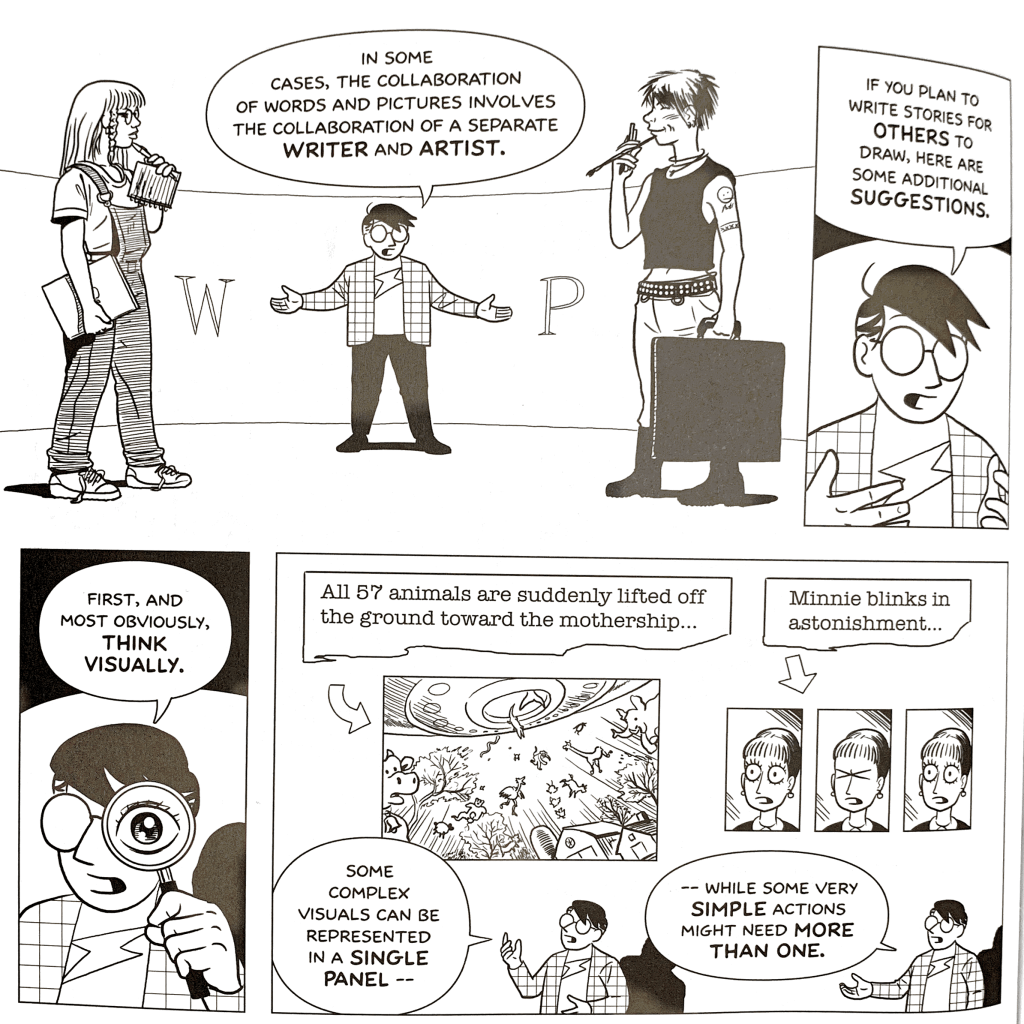
There’s plenty of how-to guides for making comics out there. Still, I can’t think of one as comprehensive as Scott McCloud‘s Making Comics.
Though first published in 2006, Making Comics: Storytelling Secrets of Comics, Manga, and Graphic Novels holds up. Even chapter 7, The Comics Professional, still shares sage advice to aspiring comic writers and artists alike.
As I continue reading The Name of the Wind, I keep noticing Patrick Rothfuss drop small wisdom nuggets in each chapter.
Some of them apply to the real world:
On doing business with a tinker:
Still, it’s never wise to look eager to sell.
The Name of the Wind: 10th Anniversary Deluxe Edition, pg 524. Patrick Rothfuss
On negotiating for a horse:
I spoke with certainty in my voice, but no hope in my heart. He was a gorgeous animal, and his coloring made him worth at least twenty talents. Still I’d go through the motions and hope to squeeze the man down to nineteen.
The Name of the Wind: 10th Anniversary Deluxe Edition, pg 519, 520. Patrick Rothfuss
On using common sense when dating:
I might not be one of you University folk, but I can see the moon on a clear night. I’m smart enough not to stick my hand in the same fire twice.
The Name of the Wind: 10th Anniversary Deluxe Edition, pg 491 Patrick Rothfuss
Great is language….it is the mightiest of sciences,
It is the fulness and color and form and diversity of the
earth….and of men and women….and of all
qualities and processes;
It is greater than wealth….it is greater than buildings or
ships or religions or paintings or music.
Let Walt Whitman bring in 2020.
Happy New Year!
From: Leaves of Grass 150th Anniversary Edition (Penguin Classics), pgs.158

It’s been 6 years since Boxers and Saints was released, but it’s still an underrated set of graphic novels. Gene Luen Yang created an ambitious work, writing and drawing two separate graphic novels that tells both the Conservative Chinese and Christian/foreigner sides of the Boxer Rebellion.
Boxers and Saints acts as an excellent entry point for a time in history mostly unknown to non-Chinese Americans. Instead of picking up a doorstop tome on Chinese history, Gene Luen Yang shares the horrors and sadness of a story in a memorable form, leaving a kernel of curiosity for readers to explore further.
I’m only forty pages in and Gene Luen Yang isn’t bullshitting around. This is a brutal tale, and one that deserves more attention.
I first read David Winner’s Brilliant Orange fifteen year ago. My first motives for reading the book were naive. I was an aspiring professional footballer. I’d read any book I could find on football, hoping to discover a professional path to imitate. It proved to be an impossible profession. When you’re sixteen, you have no hint to how the world works. You believe, and rightly so, that anything is possible. At nineteen I accepted my lifetime amateur footballer card. I continued my reading however, searching for inspiration or secret training exercises to improve my game. If I was an amateur, I wanted to be the best amateur among my peers. Fifteen years on, my motives to read Brilliant Orange has changed. I returned to the book to see how much the football world, in particular Dutch football, has changed. And in doing so, how much I have changed as well.
The truth in man is no dictum….it is vital as eyesight,
If there be any soul there is truth….if there be man or
woman there is truth….If there be physical or
moral there is truth,
If there be equilibrium or volition there is truth…..if
there be things at all upon the earth there is truth.
O truth of the earth! O truth of things! I am determined
to press the whole way toward you,
Sound your voice! I scale mountains or dive in the sea
after you.
Walt Whitman often speaks of balance in his poems by calling out life’s opposite forces.
If there be man or woman there is truth…
If there be physical or moral…
I scale mountains or dive in the sea…
Each example is an opposite. Each noun or verb needs the other to exist.
From: Leaves of Grass 150th Anniversary Edition (Penguin Classics), pgs.158
The night is like warm velvet around them. The stars, burning diamond in the cloudless sky, turn the road beneath their feet a silver grey. The University and Imre are the hearts of understanding and art, the strongest of the four corners of civilization. Here on the road between the two there is nothing but old trees and long grass bending to the wind. The night is perfect in a wild way, almost terrifyingly beautiful.
The three boys, one dark, one light, and one-for lack of a better word-fiery, do not notice the night. Perhaps some part of them does, but they are young and drunk, and busy knowing deep in their hearts that they will ever grow old or die. They also know that they are friends, and they share a certain love that will never leave them. The boys know many other things, but none of them seem as important as this. Perhaps they are right.
The Name of the Wind. By Patrick Rothfuss, pg 412, chapter 59
What Patrick describes here is that one perfect night in your twenties, when you and your buddies are coming home from a night on the town.
The only missing part of the description is a Waffle House.
 Floodlights and Goalposts