What a large volume of adventures may be grasped within this little span of life by him who interests his heart in everything.
McCullough, David. John Adams. United Kingdom, Simon & Schuster, 2001. pg 287
An online commonplace book
What a large volume of adventures may be grasped within this little span of life by him who interests his heart in everything.
McCullough, David. John Adams. United Kingdom, Simon & Schuster, 2001. pg 287
Thanks to Madame Lafayette, they were seated in a gallery overlooking the choir, “as good a place as any in the church,” thought John Quincy, who in a long description of the spectacle in his diary demonstrated that besides being precociously erudite, he had learned, as his father urged, to observe the world around him and was well started on becoming an accomplished writer. He described the Parliament lined up to the right side of the choir, robed in scarlet and black, the Chambre des Comptes on the left, in robes of black and white; the bishops arriving two by two, “a purple kind of mantle over their shoulders,” the Archbishop of Paris, “a mitre upon his head,” and finally the arrival of the King.
John Quincy Adams heeding his father’s advice to observe the world around him.
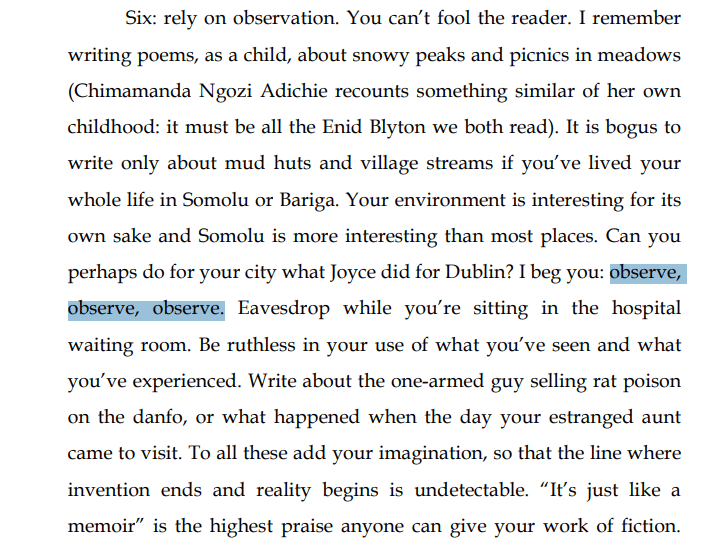
Or as Teju Cole begs: observe, observe, observe.
McCullough, David. John Adams. United Kingdom, Simon & Schuster, 2001. pg 327
“Being interested is what is scarce.”
– Tyler Cowen
I’ve listened to this podcast 5, 6 times, pulling out a new insight from each listen. It’s an excellent primer on John Stuart Mill.
Start with Autobiography. It will get you interested. And listen to the podcast in full here.
“Reading John Stuart Mill.” The Common Reader (podcast), featuring Tyler Cowen, hosted by Henry Oliver, December 11, 2023. https://www.commonreader.co.uk/p/tyler-cowen-reading-john-stuart-mill.
The natural flights of the human mind are not from pleasure to pleasure, but from hope to hope.
– Samuel Johnson, RAMBLER, No. 2
Johnson, Samuel. Samuel Johnson: Selected Works (The Yale Edition). Edited by Howard D. Weinbrot and Robert DeMaria Jr., Yale University Press, 2020 pg. 9
Lucas took it all in, reading books and comics, watching movies, filing away the bits and pieces he liked, discarding what he didn’t. “I researched kids’ movies and how they work and how myths work,” Lucas said, “and I looked very carefully at the elements of films within that fairy tale genre which made them successful. I found that myth always took place over the hill, in some exotic, far off land. For the Greeks, it was Ulysses going off into the unknown. For America it was out West. . . . The last place left ‘over the hill’ is space.”
May the Fourth be with you.
Jones, Brian Jay. George Lucas: A Life. United States, Little, Brown, 2016. pp179
There I think the attitude of Epictetus helps guide one to the right reaction. He thought every mischance in life, however bad, created an opportunity to learn something useful, and one’s duty was not to become immersed in self-pity but to utilize each terrible blow in a constructive fashion.
– Charlie Munger
Munger, Charles T.. Poor Charlie’s Almanack: The Essential Wit and Wisdom of Charles T. Munger. N.p., Stripe Matter Incorporated. pp279
Edgar Davids was one of the first players I talked to in my capacity as coach of Juventus. I liked him a lot, and I told him so immediately: “I like the way you play, your aggression, your determination, your decisiveness. It’s clear that you never yield the initiative, that you’re a fighter, a battler.” I went on to catalog his physical endowments, his skills, and his natural gifts. He just stared at me and never said a word. More than a stare, he glared at me, like I was a turd he’d accidentally stepped on. He listened, closemouthed. Finally, when I stopped talking, he enunciated a concept: “You know, I can play football too.” True, though technique was never his strong suit.
– Carlo Ancelotti
Surprising to read that Ancelotti felt technique wasn’t David’s strength. Ancelotti is correct, David’s tenacity and battling spirit stood out above all, but Davids also continued that Dutch tradition of exceptional technique.
Ancelotti, Carlo., Alciato, Aleesandro. Carlo Ancelotti: The Beautiful Game of an Ordinary Genius. United States: Random House Digital-Wholesale, 2010. pp145
Yet I had not been many days shut up with them before I began to be ashamed of my first judgement, when I had drawn away from them at the Ferry pier, as though they had been unclean beasts. No class of man is altogether bad, but each has its own faults and virtues; and these shipmates of mine were no exception to the rule. Rough they were, sure enough; and bad, I suppose; but they had many virtues. They were kind when it occurred to them, simple even beyond the simplicity of a country lad like me, and had some glimmerings of honesty.
– David Balfour
First judgements can cloud truth.
Stevenson, Robert Louis. Kidnapped. New York: Running Press, 1989. pp58
He has indeed made many different kinds of lines. An art historian could put together a chronology of his career just in terms of the multiplicity of diverse lines that he has produced. In the late 1960s and early 1970s, for example, there were the ultra-thin marks made by a kind of pen called a Rapidograph, with which he created drawings modelled with line alone — no shadows. Then, quite different, the works in coloured crayon and pencil of the early 1970s; the chunkier reed-pen strokes of portraits from the end of the decade, such as the poignant one of his mother done just after his father died in February 1979 ( not 1978, the date inscribed on the drawing); the later ones drawn with a brush, including watercolours from 2003; the extraordinary charcoal landscapes of the Arrival of Spring 2013; and on and on.
– Martin Gayford
A career life in lines sounds like a good one to aspire to.
Gayford, Martin, and Hockney, David. Spring Cannot Be Cancelled: David Hockney in Normandy. United Kingdom, Thames & Hudson, 2021. pp83
 Floodlights and Goalposts