Quit your complaining. It’s not the world’s fault that you wanted to be an artist. It’s not the world’s job to enjoy the films you make, and it’s certainly not the world’s obligation to pay for your dreams. Nobody wants to hear it. Steal a camera if you must, but stop whining and get back to work.
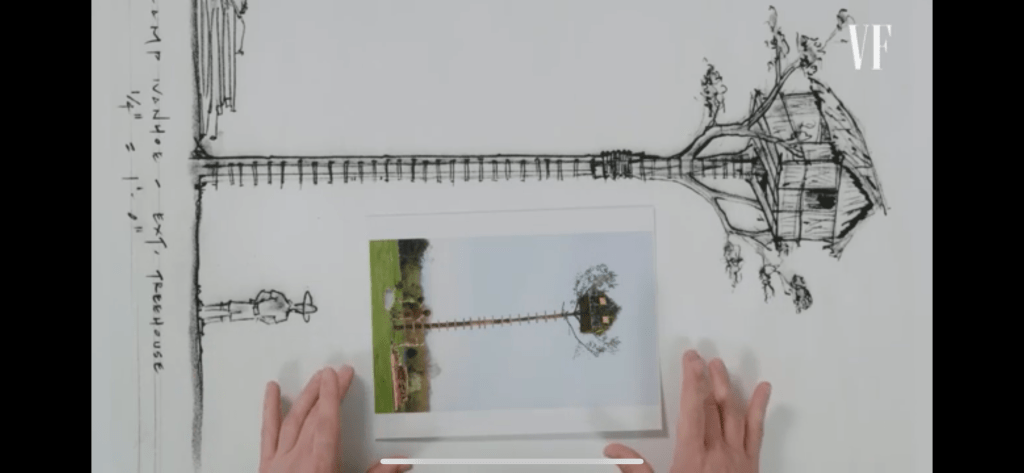
Wes looked at it and said, it’s just not extreme enough. You know, we want a tree house that’s dangerous. That’s the point of this, is that it’s just too much. We wanted to make the whole thing based on a telephone pole that was sunk into the ground. It had to be multiple trees tied together and that’s what you see here is, is one tree tied on to another.
When you’re talking about how we see these sets its really fun to be able to cheat massively, you know and to say well this is the tree house and it’s actually five foot, by four foot, by three foot, when you look at it from the outside. When you look at it from the inside its twenty feet wide and there’s sixteen kids having a conversation in there. There’s no augmentation to this at all. It’s exactly what you see here.
Herzog’s film school memories of a local family who took him in.
I loved the Franklins. With them, I got to know some of the best and deepest things about America. Later on, I invited them to Munich and took them to a party in Sachrang, the remote Bavarian village where I grew up. Hugs, beer, squeals. Contact became harder as much of the family, Billy included, seemed to fall further into religion. When I played the villain in a 2012 Hollywood action movie–it was called “Jack Reacher,” and the star, Tom Cruise, wanted me–the filming took place in Pittsburgh. But I couldn’t find the Franklins. I drove out to Fox Chapel. Almost everything in the area had changed; there were new buildings everywhere; it was depressing. The Franklins’ home was mostly unchanged; the lawn had the same old broad-leaved trees, but the path down to the garage was overgrown with flowering shrubs. There was no one home. I tried the neighbors, and learned that the house had changed owners several times. I knew that Evelyn Franklin had died. Two years later, I heard that Billy had died, too. He had been like a brother to me.
Herzog, Werner. (2023, August 21). The Mysteries of Pittsburgh. The New Yorker, 5–12. Retrieved from [https://www.newyorker.com/magazine/2023/08/28/the-mysteries-of-pittsburgh]
The best part of Werner Herzog is that you never know where he’ll appear – Mexico, Jack Reacher, The Mandalorian, Pittsburgh?
Normally the world is organized around dull people. Most power is controlled in this world by people who are straight and narrow. Where as the personal and professional eclectic person like Oppenheimer, the maverick, this kind of person is treated as unsound and is held at a distance. And only at special moments the world seems to be able to use these people.
When this kind of maverick was brought in to influence and around himself created an organization three thousand or six thousand interesting people, and you can imaging the kind of people who would rally around his recruitment efforts. When he would reach out and make the phone calls to people all over the world, what kind of people would he attract? He would look for the clever ones. He would not look for the obedient ones. And that’s how they did this amazing thing called the Manhattan Project. And then after the war ended the state did not need him and then you got back to the worst instincts of the people who start complaining that oh this guy is unsound in so many ways and do you know “x” about his personal life. And did you know he went and studied Sanskrit, and he takes interest in Hinduism and things like that.
First Steven Spielberg, who is, if you make movies, if you direct movies, this is somebody who can help you. You look to his movie for solutions. He usually found a way to do it right. He’s one of my favorites.
Zissou has an almost magical connection to the life of the sea. He speaks its language fluently. I’ve never met a boy like that in all my life.
– Lord Mandrake
Zizou:
Zidane is the soccer player who, in my life, produced the greatest array of chills, thrills, and sheer enjoyment—a living spectacle who put on an amazing show every single day. The best description of him that I ever heard came from Jose Altafini: “The way he used his foot, it was as if he were spreading butter on a slice of bread.”
He is a free man,” De Laurentiis said of Spalletti. “After 50 years in cinema [as producer], and so many exclusives with directors, actors, when someone comes to you and says: ‘After all, I’ve done my best, a cycle of my life has ended, I still have a contract with you, but I’d rather have a sabbatical year.’ What are you going to do, are you going to oppose it?
“You have to be generous in life, I never expect anything in return. He gave us, I thank him, now it’s right that he continues to do what he loves to do.”
When Napoli owner Aurelio De Laurentiis speaks we quote him. Might he be the most underrated owner in football? Maybe the most underrated character in football?
In 1974, I took a series of train trips all across India, as my father introduced me to the relatives I’d never had a chance to meet in my faraway English schools and home. Every detail of The Hero clamored around our compartment: the faces at the window, waving tiny cups of tea; the moralists eager to lecture anyone on everything; the slightly obsequious waiter explaining that there was nothing to drink but Coca-Cola. None of us in the carriage would have been surprised that the man who pontificated most furiously on the importance of liberating women would prove to be the one most eager to exploit them; projection can take many forms.
We’ve talked about reading “upstream” with your favorite authors, but I’m finding it a helpful practice with your favorite filmmakers too. For example ask yourself, what movies did Wes Anderson watch? What movies did he love? Then go watch those movies, and you’ll soon see the inspirations reveal themselves.
Satyajit Ray was an enormous influence on Wes Anderson. With each interior train hallway shot from The Hero, I kept thinking “Oh! That shot is in the Darjeeling Limited!”
These pamphlets in Wes Anderson’s Criterion Collections are worth the price of admission. They’re filled with drawings, interviews, and behind- the-scenes insights. An analog version of a blu-ray’s bonus features.
Here Wes shares a glimpse of his process:
When I’m writing, I keep notebooks of my ideas for sets, props, and clothes. I incorporate some of these ideas into the script, but I set the majority of them aside to give privately to the different department heads during preproduction. In the past, I have occasionally forgotten some of my favorite ideas until it was too late – – for example, after the movie is out on video. To prevent this from happening on THE ROYAL TENENBAUMS (which contains more perhaps unnecessary visual detail than both my previous films combined), about three months before we started shooting, I asked my brother Eric, a skilled illustrator, to help me create a set of drawings that would include much of the information I wanted to communicate to the crew — and that would also suggest the overall look and feeling of the movie.
We had already found the house where I wanted to film (in the Hamilton Heights section of Harlem), and our production designer, David Wasco, had provided us with a set of blueprints, so I was able to very specifically plan the contents and arrangements of each of the rooms, and Eric was able to meticulously render them. Eric was, in fact, so meticulous that many of the sets had already been constructed by the time he finished the drawings. Eventually, however, his illustrations became the standard equipment on the walls of the production offices and art department and in the notebooks of everyone on the crew — a sort of manual to keep next to your script. We include a copy here for you.
— Wes Anderson
Criterion Collection Pamphlet. The Royal Tenenbaums
Is Wes Anderson the filmmaker with the highest percentage of his movies in the Criterion Collection? 9 from 10? I’m sure the French Dispatch is lurking at the door.
 Floodlights and Goalposts