Shasta cried only a very little; he was used to hard knocks.
Lewis. C.S.. The Horse and His Boy. New York: Harper Collins, 2002.
Annie. Jay-Z. C.S. Lewis. The phrase “hard-knocks” has been around since 1870.
An online commonplace book
Shasta cried only a very little; he was used to hard knocks.
Lewis. C.S.. The Horse and His Boy. New York: Harper Collins, 2002.
Annie. Jay-Z. C.S. Lewis. The phrase “hard-knocks” has been around since 1870.
E.M. Nicholson‘s book The Art of Bird Watching recommends keeping a card system to document bird sightings:
Along with the field notes (which, according to Nicholson, had to be made in the field within the first few minutes of the sighting), Nicholson also advised his readers to make another, more detailed and permanent record. This, he said, should be something like a card system, and most certainly, ‘not a record in diary form which’, he remarked, ‘soon becomes unmanageable.’
Baker ignored this. He took up the diary form. Which makes sense considering Baker’s literary tendencies:
Yet a record in diary form was exactly what Baker chose to write when he started his ‘systematic watching’. At the end of each outing he would come home and write up the day’s field notes into the exercise books he kept in the spare bedroom which he had converted into his study. Here he kept other kinds of birding notes that also went beyond Nicholson’s remit of a useful permanent record. Sometimes these included flowers or feathers that he had brought home, often for Doreen but also for himself as tokens of the day’s expedition and inspiration for his writing.
and
He kept cardboard folders, too, for his other natural history research, on the covers of which he wrote lists of suggested contents. One read: ‘Speculations / Introductions / Valley / Topography / Geology / History / Species Occurring / Peregrine in Essex / Essex Generally / Arrival & Choice of Territory … ‘ ‘ Unmanageable’ might have been Nicholson’s description – and perhaps this was just part of Baker’s unmanageable nature – but in any case Baker seemed to manage it quite well.
I have the suspicion Baker enjoyed this ‘unmanageable’ process. All the detail and time it demanded likely helped him absorb the information even deeper.
Discover your own process. What’s unmanageable to some, could be your ideal.
Saunders, Hetty. My House of Sky: The life and work of J.A. Baker. Lower Dairy, Toller Fratrum, Dorset: Little Toller Books, 2017.
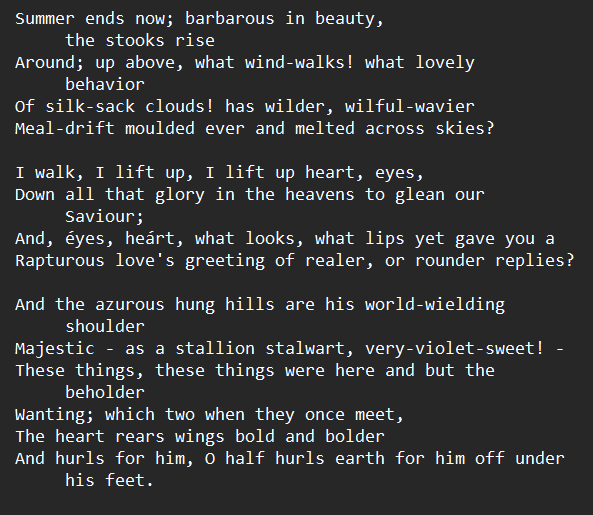
Hopkins, Gerard Manley. Hopkins: Poems (Everyman’s Library Pocket Poets Series) London: Everyman’s Library, 1995.
From Will O’Brien’s piece in the Fitzwilliam
Taken over its entire history, Guinness may just be the most successful company Ireland has ever produced. In 1930, it was the seventh largest company in Britain or Ireland. It is one of our oldest companies of note. Considering that it predates the Bank of Ireland and the State itself, it could even be said that Guinness is the longest-running successful large institution in Ireland.
Will O’Brien
The Irish brewing company has relentlessly innovated on multiple fronts.
Guinness is proof that companies who endure, innovate across multiple areas of their business over an extended timeline. Innovation doesn’t pause.
A must read piece if you’re interested in history, economics, marketing, or beer.

So much in one tweet.
Inspiring. Picture Fermat coming home from the office and working on maths after dinner, for fun. What’s your after dinner fun?
Interesting how ambition can fluctuate between people, but success occur. Colossal Descartes. Modest hobbyist Pierre de Fermat. Both with immense contributions to mathematics. Descartes inventing analytic geometry, and Fermat the “founder” of the modern theory of numbers.
How does a lawyer from Toulouse go on to be what Britannica calls “one of the two leading mathematicians of the first half of the 17th century“?
(Boyer, Carl B.. “Pierre de Fermat”. Encyclopedia Britannica, Invalid Date, https://www.britannica.com/biography/Pierre-de-Fermat. Accessed 19 September 2023.)
h/t @netcapgirl
Are you an artist?
Never. All I’ve ever wanted to be is a foot soldier of cinema. My films aren’t art. In fact, I’m ambivalent about the very concept of “the artist” It just doesn’t feel right to me. King Farouk of Egypt, in exile and completely obese, wolfing down one leg of lamb after another, said something beautiful: “There are no kings left in the world any more, with the exception of four: the King of Hearts, the King of Diamonds, the King of Spades and the King of Clubs.” Just as the notion of royalty is meaningless today, the concept of being an artist is also somehow outdated. There is only one place left where you find such people: the circus, with its trapeze artists, jugglers, even hunger artists. Equally suspicious to me is the concept of “genius,” which has no place in contemporary society. It belongs to centuries gone by, the eras of pistol duels at dawn and damsels in distress fainting onto chaises longues.
Cronin, Paul. Werner Herzog – A Guide for the Perplexed. London: Faber & Faber, 2020. pp147
Herzog also claims his films are poetry, not art. And prefers a craftsman’s approach:
What are your films, if not art?
Poetry. I’m a craftsman, and feel closest to the late-mediaeval artisans who produced their work anonymously – like the master who created the Köln triptych – and never considered themselves artists. To remain anonymous behind what you have created means the work has a stronger life of it’s own, though today, in our increasingly connected world, it’s an illusion to think you can remain hidden. Along with their apprentices, artisans had a genuine understanding of and feeling for the physical materials they worked with. Every sculptor before Michelangelo considered himself a stonemason; no one thought of himself as an artist until maybe the late fifteenth century. Before that they were master craftsmen with apprentices who produced work on commission for popes or Burgermeisters. Once, after snow had fallen in Florence, a particularly idiotic member of the Medici family asked Michelangelo to build a snowman in the courtyard of the family villa. He had no qualms about stepping outside, without a word, and completing this task. I like this attitude of absolute defiance.
Cronin, Paul. Werner Herzog – A Guide for the Perplexed. London: Faber & Faber, 2020. pp147
I wonder if Herzog’s claim that no one considered themselves artists until around the late 15th century is true.
If true, what triggered the change?
Was it more wealth, allowing master craftsman to create “art” in their spare time?
Was it the availability of materials? Did “art” supplies increase in abundance around the 15 century?
Werner Herzog – A Guide for the Perplexed is the modern day Hitchcock by Truffaut.
Brilliant weirdos Alexey Guzey and Brian Timar explain morale. Worth bookmarking this one for discouraging moments. It could help you figure out why your morale is low.
First, ponder this idea:
Morale is your motive force, and you live or die by its maintenance.
Brian Timar & Alexey Guzey
Alexey and Brian go on to share a list of 10 + things that increase and decrease morale.
Three Four morale boosters from their list that resonate:
11. doing
35. making a decision
3. going outside
13. stopping a thief
Three morale sappers to be wary of:
4. being a coward
5. punting decisions
9. spending time on a task and not feeling closer to finishing it
Consider morale booster #11 – doing. Don’t only read these, go on and create your own list of morale increasers.
Some increasers (sunlight) are perennial, but many more will be personal. Same applies with morale sappers (sleepiness).
Read the piece in full here. Also, pair with Guzey’s post: Why You Should Start a Blog Right Now

“Love work” is different than “Love what you do”—for the injunction is less about finding the right work to love and more about finding any work to love. If romanticism suggests that there is only one thing that you can do and be happy, Shemaiah’s approach is closer to the logic behind arranged marriage: once you are prepared to love work your work becomes lovable. Meanwhile, the FOMO caused by wondering “Am I in the right line of work?” leads to restlessness. As the average time in any one job or company declines, one contributing factor may be the grass is always greener effect. A person who eschews status will not be as prone to this fallacy.
Atkins, Zohar. “Love The Work.” What Is Called Thinking?, 2023.
https://whatiscalledthinking.substack.com/p/love-the-work. Accessed 16 September 2023.
Read Zohar’s full piece here. And pair with Dorthy Sayers opening paragraph from her essay Why Work?
I have already, on a previous occasion, spoken at some length on the subject of Work and Vocation. What I urged then was a thoroughgoing revolution in our attitude to work. I asked that it should be looked upon, not as a necessary drudgery to be undergone for the purpose of making money, but as a way of life in which the nature of man should find its proper exercise and delight and so fulfill itself to the glory of God. That it should, in fact be thought of as a creative activity undertaken for the love of work itself; and that man, made in God’s image, should make things, as God makes them, for the sake of doing well a thing that is well worth doing.
Sayers, Dorothy. Letters to a Diminished Church: Passionate Arguments for the Relevance of Christian Doctrine. Nashville: Thomas Nelson Publishing, 2004.
I think both Dorthy and Zohar would agree on the idea that work is a noble pursuit on its own. But Dorthy takes the idea a step further, proposing the argument that work shouldn’t be taken on for only the purpose of earning money, but rather as an essential part of bringing glory to God.
Challenging and encouraging throughout.
having gone about as high up Hemingway Mountain as I could go, having realized that even at my best I could only ever hope to be an acolyte up there, resolving never again to commit the sin of being imitative, I stumbled back down into the valley and came upon a little shit-hill labeled “Saunders Mountain.”
“Hmm,” I thought. “It’s so little. And it’s a shit-hill.”
Then again, that was my name on it.
This is the big moment for any artist (this moment of combined triumph and disappointment), when we have to decide whether to accept a work of art that we have to admit we weren’t in control of as we made it and of which we’re not entirely sure we approve. It is less, less than we wanted it to be, and yet it’s more, too –it’s small and a bit pathetic, judged against the work of the great masters, but there it is, all ours.
What we have to do at that point, I think, is go over, sheepishly but boldly, and stand on our shit-hill, and hope it will grow.
And–to belabor this already questionable metaphor–what will make that shit-hill grow is our commitment to it, the extent to which we say, “Well, yes, it is a shit-hill, but it’s my shit-hill, so let me assume that if I continue to work in this mode that is mine, this hill will eventually stop being made of shit, and will grow, and from it, I will eventually be able to see (and encompass in my work) the whole world.”
Saunders, George. A Swim in a Pond in the Rain: In Which Four Russians Give a Master Class on Writing, Reading, and Life. New York: Random House, 2021. pp108-109
Own your shit-hill. It frees you to make progress.
David Perell calls it a “mark of maturity”
If you know how to write the alphabet you can draw this map.
JP Coovert
Two types of maps JP demonstrates.
JP suggests starting with a “key” first. This will help keep all of the icons on your map consistent.
Great game for a Sunday afternoon or waiting for your food at the Olive Garden
 Floodlights and Goalposts