Every drawing you undertake has a hierarchy. There are the general elements. And there are the fine details.
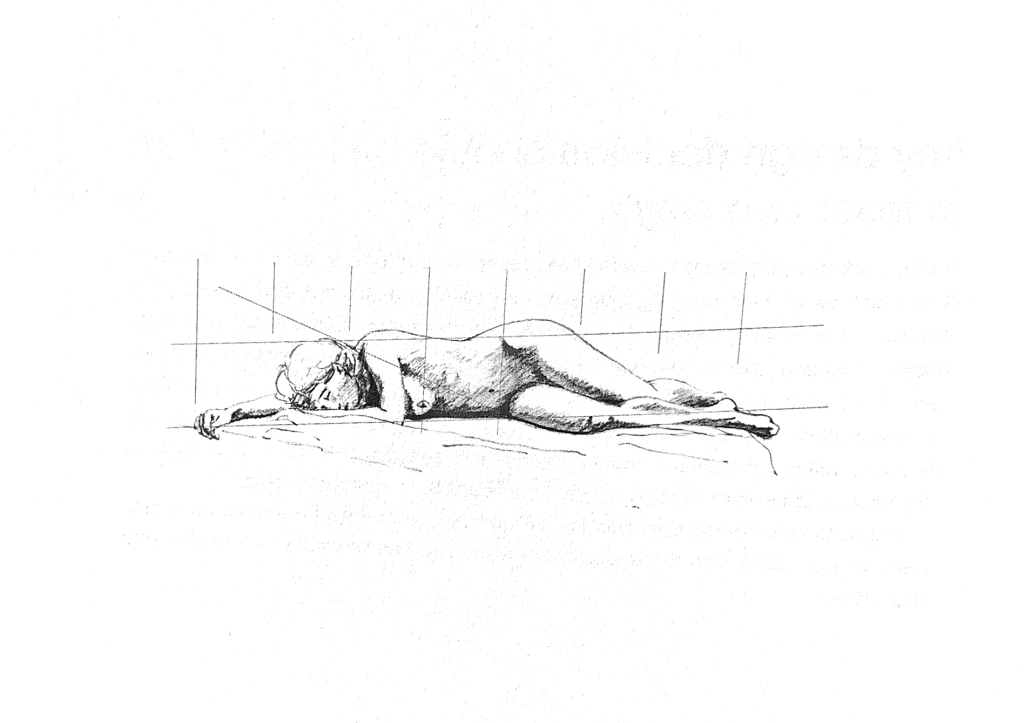
Matthew Frederick recommends laying out the entire drawing to start.
How?
By making use of:
Light guide lines.
Geometric alignments.
Visual gut-checks.
These techniques will help ensure the proportions and placement of shapes are accurate.
After that hit the details. But don’t over indulge in one place:
When you achieve some success at this schematic level, move to the next level of detail. If you find yourself focusing on details in a specific area of the drawing, indulge briefly, then move to other areas of the drawing.
When laid out this way, it would appear that the art of the sample, in the mind of Q-Tip, was science. He began by laying out pause tapes in his home until 1989, when he had the opportunity to be present for the recording of De La Soul’s iconic album Three Feet High and Rising. It was in those moments when he was shown around the studio by the in-house recording engineers and afterward was allowed to tinker with all the sampling devices. Seeing his potential and interest, the rapper and producer Large Professor taught him how to use other studio equipment to most effectively hone his sound. Not all young producers have a group of welcoming mentors like Q-Tip had, but not all young producers were as uniquely skilled from their teenage years as Q-tip was, and not all were as willing as Q-Tip to “dig deep in the crates” to search for sounds. Q-Tip was, in many ways, an extension of rap’s early DJs, chipping away at a massive block of music and peeling off only what he needed.
To release some of his jumpy energy and his mind’s ceaseless inventorying and inquisitiveness, Thurber drew. It was as habitual as his smoking. Writing-rewriting, as he often called it- required discipline, focus, research, an amped-up armature of full brain power that included memory, grammar, word and sentence sounds, a dialing in of the humorous of and the heartfelt, the meandering and the meaningful. But drawings? He considered his to be fluid, spontaneous, unhindered, and with rarely a need for erasure, revision, or polish. His daughter Rosemary remembers her father saying that he could even whistle while he drew.
A Mile and a Half of Lines: The Art of James Thurber, by Michael J. Rosen
If you’re looking for some artistic inspiration, or need to smile, pick up A Mile and a Half of Lines. After skimming through five or ten pages you’ll be feening to pick up a pencil and draw.
January’s winds are merciless, splitting open dry knuckles with blood slivers. 9-to-5ers power-walk the final two blocks to their warm cubicles and electric standing desks.
A few trees down from the office, in-front of Heavy Burger, a strange collection of city trash lies. A toppled lime electric scooter, neck twisted, lays between the road and the side walk. An aluminum silver Baby Ruth candy bar wrapper flaps next to the handlebars. And a nylon purple poncho, a size 8 step away from the wrapper, collects rain in its creases.
You’re standing in one place, one patch of grass on a sunny Saturday afternoon in Seville, playing a game, which is to say doing your job, which is playing a game. A ball floats in the air toward you. You’re in one place and you’re in all possible places. Your name is stamped between your shoulder blades. You turn your back away from the ball. We all know who you are. You balance yourself and focus. What you’re about to do has no name.
From: They Think They Know You, Lionel Messi. By: Rowan Ricardo Phillips. The Paris Review, February 26 2019
I love finding pieces on footballers from outside of traditional football journalism. Especially when a masterful writer can share a new vision.
Rowan Ricardo Phillips accomplishes a rare feat with his Paris Review piece: They Think They Know You, Lionel Messi. He helps us relish, treasure again, this moment where we still have the opportunity to watch Lionel Messi at the peak of his powers.
Paglia: Like a medieval monk, I laboriously copied out passages that I admired from books and articles — I filled notebooks like that in college. And I made word lists to study later. Old-style bound dictionaries contained intricate etymologies that proved crucial to my mastery of English, one of the world’s richest languages.
I feel that the basis of my work is not only the care I take with writing, with my quality controls, my prose, but also my observation. It’s 24/7. I’m always observing. I don’t sit in a university. I never go to conferences. That is a terrible mistake. A conference is like overlaying the same insular ideology on top of it. I am always listening to conversations at the shopping mall.
COWEN: My last question before they get to ask you, but I know there are many people in this audience, or at least some, who are considering some kind of life or career in the world of ideas. If you were to offer them a piece of advice based on your years struggling with the infrastructure, and the number of chairs, and whatever else, what would that be?
PAGLIA: Get a job. Have a job. Again, that’s the real job. Every time you have frustrations with the real job, you say, “This is good.” This is good, because this is reality. This is reality as everybody lives it. This thing of withdrawing from the world to be a writer, I think, is a terrible mistake.
Number one thing is constantly observing. My whole life, I’m constantly jotting things down. Constantly. Just jot, jot, jot, jot. I’ll have an idea. I’m cooking, and I have an idea, “Whoa, whoa.” I have a lot of pieces of paper with tomato sauce on them or whatever. I transfer these to cards or I transfer them to notes.
I’m just constantly open. Everything’s on all the time. I never say, “This is important. This is not important.” That’s why I got into popular culture at a time when popular culture was — .
In fact, there’s absolutely no doubt that at Yale Graduate School, I lost huge credibility with the professors because of my endorsement of not only film but Hollywood. When Hollywood was considered crass entertainment and so on. Now, the media studies came in very strongly after that, although highly theoretical. Not the way I teach media studies.
I also believe in following your own instincts and intuition, like there’s something meaningful here. You don’t know what it is, but you just keep it on the back burner. That’s basically how I work is this, the constant observation. Also, I try to tell my students, they never get the message really, but what I try to say to them is nothing is boring. Nothing is boring. If you’re bored, you’re boring.
The boisterous knot of away fans, the intense running patterns, the knot of men in coats on the touchline: there is something collegiate and tightly bonded about Leeds, like watching a brilliantly well-planned travelling stag do unfold before your eyes.
Barney Roney describing Bielsa-ball at the Emirates.
This wasn’t a planned joint reading adventure, but there was a natural connection between the two – the deep adoration both authors shared for their temporary homes.
Lahiri on the sounds of Florence that captured her:
– But from the start my relationship with Italy is as auditory as it is visual. Although there aren’t many cars, the city is humming. I’m aware of a sound that I like, of conversations, phrases, words that I hear wherever I go. As if the whole city were a theater in which a slightly restless audience is chatting before the show begins. I hear the excitement of children wishing each other buon Natale – merry Christmas – on the street. I hear the tenderness with which, one morning at the hotel, the woman who cleans the room asks me: Avete dormito bene? Did you sleep well? When a man behind me on the sidewalk wants to pass, I hear the slight impatience with which he asks: Permesson? May I?
In Other Words, pg 13,15. Lahiri, Jhumpa
Hemingway on the coming Paris Spring:
With so many trees in the city, you could see the spring coming each day until a night of warm wind would bring it suddenly in one morning. Sometimes the heavy cold rains would beat it back so that it would seem that it would never come and that you were losing a season out of your life. This was the only truly sad time in Paris because it was unnatural. You expected to be sad in the fall. Part of you died each year when the leaves fell from the trees and their branches were bare against the wind and the cold, wintry light. But you knew there would always be the spring, as you knew the river would flow again after it was frozen. When the cold rains kept on and killed the spring, it was as though a young person had died for no reason.
In those days, though, the spring always came finally but it was frightening that it had nearly failed.



 Floodlights and Goalposts