He’s 5ft 6in tall and weighs 10 stone, a healthy height and weight for a well-developed 13-year-old boy. He remains an amiable, slightly goofy figure, resembling in close-up less a hyper-toned modern athlete, more a very clever gerbil with a pocket watch and a tailcoat who knows how to fly an air balloon and drive an old-fashioned car.
I start with very short pieces, usually no more than a handwritten page. I try to focus on something specific: a person, a moment, a place. I do what I ask my students to do when I teach creative writing. I explain to them that such fragments are the first steps to take before constructing a story. I think a writer should observe the real world before imagining a nonexistent one.
In order for the skillful players to have the space with which to work, somebody had to get the ball, and give it to them. The playmakers couldn’t be expected to do the running that was needed, the dirty work, the pressing. Every team had at least two players of this type, if not three.
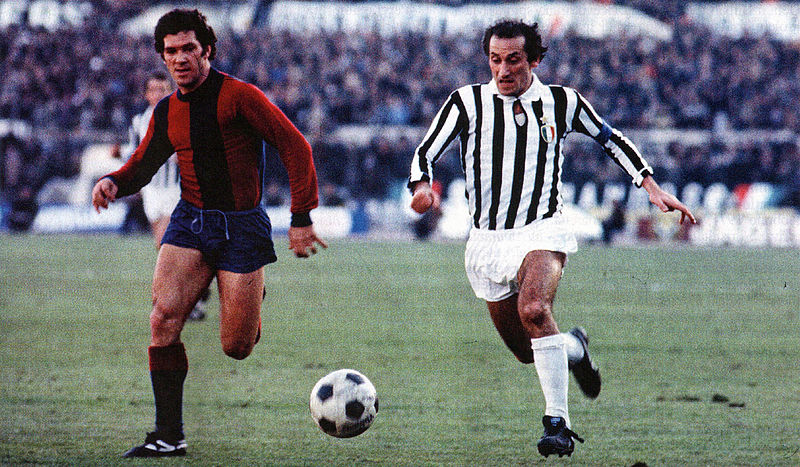
Juventus of course, had whom many consider to be the greatest mediani of all – Beppe Furino.
Beppe, to the right, in the black and white Juventus stripes
Juventus specialized in mediani, and the greatest of all was Beppe Furino in the 1970s and 1980s. Little Furino, from Palermo in Sicily, ran himself into the ground in order to get the ball to a succession of playmakers such as Franco Causio, Liam Brady and Michel Platini. Yet Furino was not a one-dimensional player. Team-mate Marco Tardelli called him ‘the most tactically intelligent player I have ever seen. He was always close to the ball.’
A mediano doesn’t revel in personal glory. But their trophy cabinets are flush with silver.
The life of a mediano was thus a melancholic one. They were always destined to be the supporting act, straight men, water carriers. They could never be stars and would remain forever in the shadow of their more skillful colleagues. Furino won a record eight titles with Juventus in the 1970s and 1980s, but is rarely mentioned in accounts of those years.
Pogba might naturally be tall, powerful, and rangy, but you can find hundreds more across Europe’s top leagues with those attributes. What marked him apart, even as a kid was his work ethic. “I remember telling the group at training one Monday to juggle the ball 50 times with their right foot, 50 times with their left, and 50 times with their head,” recalled another of his coaches at Roissy, Mamadou Papis Magassa. “Paul couldn’t do it. But he spend the next two days with a football, practicing constantly. He came back Wednesday and did it perfectly.”
One nice thing about sentences that display a skill you can only envy is that they can be found anywhere, even when you’re not looking for them. I was driving home listening to NPR and heard a commentator recount a story about the legendary actress Joan Crawford. It seems that she never left the house without being dressed as if she were going to a premiere or a dinner at Sardi’s. An interviewer asked her why. She replied, “If you want to see the girl next door, go next door.”
It is the bang-bang swiftness of the short imperative clause-“go next door”- that does the work by taking the commonplace phrase “the girl next door” literally and reminding us that ” next door” is a real place where one should not expect to find glamour (unless of course one is watching Judy Garland singing “The Boy Next Door” in Meet Me in St. Louis).
“Remember this, son, if you forget everything else. A poet is a musician who can’t sing. Words have to find a man’s mind before they can touch his heart, and some men’s minds are woeful small targets. Music touches their hearts directly no matter how small or stubborn the mind of the man who listens.”