“The wolf that one hears is worse than the orc that one fears.”
– Boromir
Tolkien, John Ronald Reuel. The Fellowship of the Ring: Being the First Part of The Lord of the Rings. United States, Ballantine Books, 1965. pg389
An online commonplace book
Secrets had an immense attraction for him, because he never could keep one, and he enjoyed the sort of unhallowed thrill he experienced when he went and told another animal, after faithfully promised not to.
Have we all felt this?
Grahame, Kenneth. The Wind in the Willows. United Kingdom, Welbeck Editions, 2021. p 200-201
A photograph is easily printed and reproduced and shared on social media. A drawing, on the other hand, is a more deliberate act. It slows me down. I do it in order to slow-jam the news.
Kumar, Amitava. The Blue Book: A Writer’s Journal. India, HarperCollins Publishers India, 2022. pg 76
The Rat pushed the paper away from him wearily, but the discreet Mole took occasion to leave the room, and when he peeped in again some time later, the Rat was absorbed and deaf to the world; alternately scribbling and sucking the top of his pencil. It is true that he sucked a good deal more than he scribbled; but it was joy to the Mole to know that the cure had at least begun.
We all need a friend like Mole.
Grahame, Kenneth. The Wind in the Willows. United Kingdom, Welbeck Editions, 2021. p165
By degrees the Rat began to sit up and to join in. His dull eye brightened, and he lost some of his listening air.
Presently the tactful Mole slipped away and returned with a pencil and a few half-sheets of paper, which he placed on the table at his friend’s elbow. “It’s quite a long time since you did any poetry,” he remarked. “You might have a try at it this evening, instead of – well, brooding over things so much. I’ve an idea that you’ll feel a lot better when you’ve got something jotted down – if it’s only just rhymes.”
At Mole’s behest Ratty returns to poetry. What feeding of the soul do you need to return to?
Grahame, Kenneth. The Wind in the Willows. United Kingdom, Welbeck Editions, 2021. p165
There he got out the luncheon-basket and packed a simple meal, in which, remembering the stranger’s origin and preferences, he took care to include a yard of long French bread, a sausage out of which the garlic sang, some cheese which lay down and cried, and a long-necked straw-covered flask wherein lay bottled sunshine shed and garnered on far Southern slopes.
Water Rat and Sea Rat sit down for a poetic lunch. Kenneth Grahame’s prose is a counter argument against “simple” prose.
Grahame, Kenneth. The Wind in the Willows. United Kingdom, Welbeck Editions, 2021. p116
My debt to Plato is a certain number of sentences: the like to Aristotle. A large number, yet still a finite number, make the worth of Milton and Shakespeare, to me. I would therefore run over what I have written, save out the good sentences, and destroy the rest.
He only is a good writer who keeps one eye on his page and with the other sweeps over things. So that every new sentence brings us a new contribution of observation.
Richardson, Robert D.. First We Read, Then We Write: Emerson on the Creative Process. United States, University of Iowa Press, 2015. pg 53,54
He was a man of immensely strong faith. A faith that balanced well with his reason.
Malcolm Guite on Dr. Johnson
What a large volume of adventures may be grasped within this little span of life by him who interests his heart in everything.
McCullough, David. John Adams. United Kingdom, Simon & Schuster, 2001. pg 287
Thanks to Madame Lafayette, they were seated in a gallery overlooking the choir, “as good a place as any in the church,” thought John Quincy, who in a long description of the spectacle in his diary demonstrated that besides being precociously erudite, he had learned, as his father urged, to observe the world around him and was well started on becoming an accomplished writer. He described the Parliament lined up to the right side of the choir, robed in scarlet and black, the Chambre des Comptes on the left, in robes of black and white; the bishops arriving two by two, “a purple kind of mantle over their shoulders,” the Archbishop of Paris, “a mitre upon his head,” and finally the arrival of the King.
John Quincy Adams heeding his father’s advice to observe the world around him.
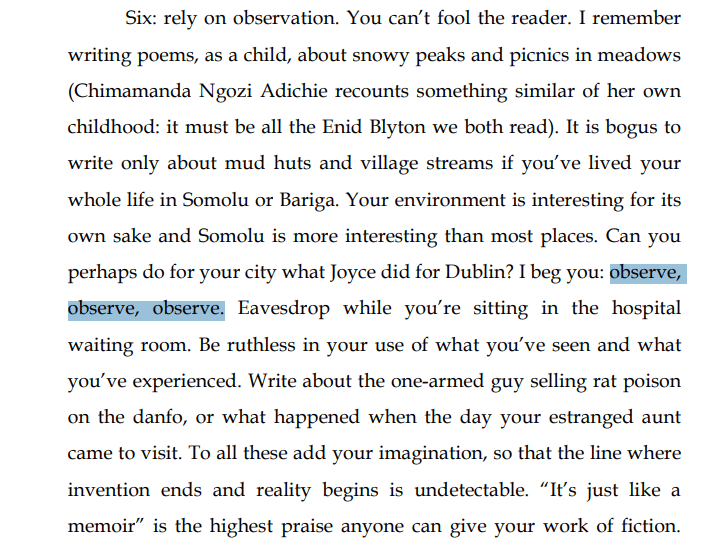
Or as Teju Cole begs: observe, observe, observe.
McCullough, David. John Adams. United Kingdom, Simon & Schuster, 2001. pg 327
 Floodlights and Goalposts