A poem for the autumnal equinox.
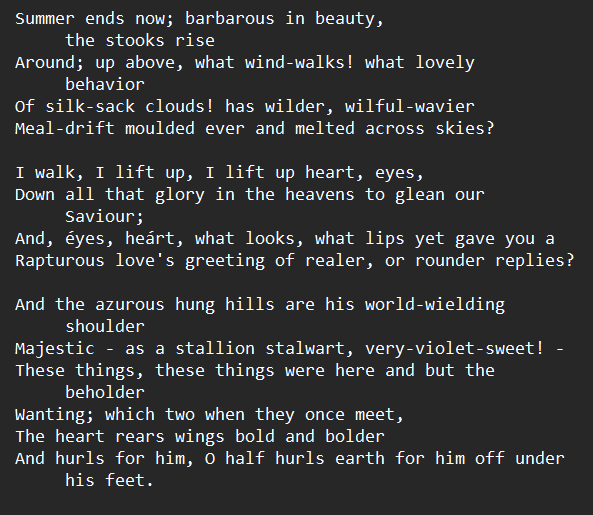
Hopkins, Gerard Manley. Hopkins: Poems (Everyman’s Library Pocket Poets Series) London: Everyman’s Library, 1995.
An online commonplace book
Hopkins, Gerard Manley. Hopkins: Poems (Everyman’s Library Pocket Poets Series) London: Everyman’s Library, 1995.
having gone about as high up Hemingway Mountain as I could go, having realized that even at my best I could only ever hope to be an acolyte up there, resolving never again to commit the sin of being imitative, I stumbled back down into the valley and came upon a little shit-hill labeled “Saunders Mountain.”
“Hmm,” I thought. “It’s so little. And it’s a shit-hill.”
Then again, that was my name on it.
This is the big moment for any artist (this moment of combined triumph and disappointment), when we have to decide whether to accept a work of art that we have to admit we weren’t in control of as we made it and of which we’re not entirely sure we approve. It is less, less than we wanted it to be, and yet it’s more, too –it’s small and a bit pathetic, judged against the work of the great masters, but there it is, all ours.
What we have to do at that point, I think, is go over, sheepishly but boldly, and stand on our shit-hill, and hope it will grow.
And–to belabor this already questionable metaphor–what will make that shit-hill grow is our commitment to it, the extent to which we say, “Well, yes, it is a shit-hill, but it’s my shit-hill, so let me assume that if I continue to work in this mode that is mine, this hill will eventually stop being made of shit, and will grow, and from it, I will eventually be able to see (and encompass in my work) the whole world.”
Saunders, George. A Swim in a Pond in the Rain: In Which Four Russians Give a Master Class on Writing, Reading, and Life. New York: Random House, 2021. pp108-109
Own your shit-hill. It frees you to make progress.
David Perell calls it a “mark of maturity”
There is a time in every man’s education when he arrives at the conviction that envy is ignorance; that imitation is suicide; that he must take himself for better, for worse, as his portion; that though the wide universe is full of good, no kernel of nourishing corn can come to him but through his toil bestowed on that plot of ground which is given to him to till.
Ralph Waldo Emerson, from Self-Reliance
Emerson is someone I often hear quoted and mentioned on podcasts, but how many have truly read him?
I had not.
As you make your way through the classics you begin to realize, they’re classics for two reasons.
One, their themes, envy in this case, are timeless. This is true for novels, essays, or epic poems.
And two, they are typically more readable than you’d first imagine. See tip #6: Read Western canonical literature.
Emerson, Ralph Waldo. The Illustrated Emerson: Essays and Poems. New York: Sterling Publishing Co., Inc. 2018
I dropped out of school, but I didn’t drop out of life.
– August Wilson
Try not to drop out of either.
Bryant, Jen. Feed Your Mind: A Story of August Wilson. New York: Abrams Books for Young Readers, 2019.
Baker took interest in the language of falconry and its history. At one point in the Peregrine he wondered whether the phrase taken by surprise came from hawking. He might well have been correct: many of these terms from falconry have crossed into everyday use and lost their hawking roots. ‘Disclosed’, for example, comes from an Old French word that described a hawk that just hatched. ‘Reclaim’, also from Old French, meant ‘to make a hawk tame, gentle, and familiar’, or to call it back to the glove. To ‘make a point’ in an argument, say, comes, too, from hunting: used of dogs but also of hawks, it describes the action when a hawk throws herself up into the air above the spot where her quarry has been driven into a covert.
Saunders, Hetty. My House of Sky: The life and work of J.A. Baker. Lower Dairy, Toller Fratrum, Dorset: Little Toller Books, 2017.
The falconry terms Baker studied aren’t obscure, or restrained to a specific discipline. Phrases like “Make a point” and words like “disclose” often appear in office conversations and emails. Considering how old falconry is, these could be considered the first sports cliches.
Joseph Roth is a master of writing images and crafting metaphors. They are true, surprising, and specific.
Consider the following passages:
He observed the immense shadows cast by small objects on the bare blue walls; the gently curved shimmering outline of his sword hanging from its hook by the door, its dark ribbon tucked into the hilt. He listened to the ceaseless rain outside drumming on leaded window frames; and rose at last, having decided to go and see his father the following week,
and
He found the old gentleman in his shirtsleeves sitting in the kitchen of his quarters at a plain deal table covered with a dark-blue cloth edged in scarlet, a large cup of steaming, fragrant coffee in front of him.
This one he repeats:
His consonants rumbled like thunderbolts, the final syllables laden with small weights.
and
“shaking him as a hurricane shakes a feeble shrub”
From:
Roth, Joseph. “The Hero of Solferino.” Leadership: Essential Writings by Our Greatest Thinkers (Norton Anthology), edited by Elizabeth D. Samet, W. W. Norton & Company, 2015, pp. 69-82.
The asceticism of intellectual life is related to what we might call the asceticism of life in general: the cancer may or may not respond to treatment; a woodworker or an engineer must accept the limitations of the materials, regardless of the grand vision he or she began with; there are some stains that just will not come out, no matter how important the garment is; the office can hire and fire as much as it likes, but in the end only the people who work there can accomplish its tasks. The encounter with a given reality, and the resultant crushing of our desires and hopes, is an essential part of being a human being. Every mode of learning is a school of hard knocks.
– Zena Hitz
Hitz, Zena. Lost in Thought: The Hidden Pleasures of an Intellectual Life. Princeton. Princeton University Press, 2020. (see pgs 86-87)
And every time I attempted it I failed — There was no correspondence. So my failure as an artist, what you can’t do, I think further propelled me into the art of writing. But now, drawing interests me because having accomplished — but because writing has become easy, to a great extent, the taking up drawing is an entry into what I can’t do. Is an entry into the art of the amateur. And therefore it is discovery — it doesn’t matter if I fail. It doesn’t matter if I am a you know a — type artist. What matters really is that I’m doing it everyday and I’m trying to do it as honestly as I can. And that’s creatively, you know? Not to be complacent about it, but to challenge one’s self.
– Amitava Kumar. From minute 37:07 – 39:27
From Amit Varma’s interview on the Seen and Unseen Podcast. Listen in full below:
Be sure to listen to the Seen and Unseen podcast. I have a feeling soon, it will explode with western audiences.
It must.
And fate? No one alive has ever escaped it,
Neither brave man nor coward, I tell you —
It’s born with us the day that we are born.
– Hector
From the Iliad, by Homer. Hector Returns to Troy.
Translated by Robert Fagles
What you also need to do is keep working on your judgment. Keep working on your judgment. That means—and this is something you do, but I’m not sure how many writers actually do it as rigorously as they should—that you have to read a lot. There’s no substitute for that. You have to read a lot. You have to read it with a critical mind. When you read a great piece, reverse engineer it. Read it again with that specific eye where you’re looking at the craft.
When you read a piece by someone you like but this particular piece hasn’t worked, do the same thing. Read it with a critical eye. Figure out why didn’t it work this time. What went wrong? Why did it feel off? You have to hone the reader in yourself, which will automatically make your judgment better, which will automatically lift your ability with it because then you’ll have to work that much harder to please the critic in you.
Rajagopalan, Shruti (2023, June 8). The Creator Economy (No. 81) Ideas of India. https://www.discoursemagazine.com/culture-and-society/2023/06/08/ideas-of-india-the-creator-economy/
Creative judgement. For those of us without editors, it’s an essential skill to hone.
Listen to Shruti’s interview with Amit in its entirety below:
 Floodlights and Goalposts