From the second stanza of To Autumn
Steady thy laden head across a brook;
Or by a cider-press, with patient look,
Thou watchest the last oozings hours by hours.

Keats, John. The Poetry of John Keats. London: Arcturus Publishing Limited, 2018.
An online commonplace book
Steady thy laden head across a brook; Or by a cider-press, with patient look, Thou watchest the last oozings hours by hours. Keats, John. The Poetry of John Keats. London: Arcturus Publishing Limited, 2018.
We rhapsodize about “New England Autumns,” and for good reason; but, really, Autumn anywhere in the deciduous forests of North America, especially in the East—from upper Canada to the deep South—is magnificent, and far outshines anything the Old World has to offer. In those years in which I have found myself in some corner of Europe during the Fall, I have never been able to suppress a certain feeling of disappointment at the limited palette nature employs there for what is surely my favorite of the seasons. This isn’t to say European Autumn is not lovely enough, with its muted light and drifting mists and pale flavescence. But the chromatic spectrum is narrow. For the most part, the trees pass from a darker to a more limpid green, and then to light gold, and then to ochre and brown, before their branches are stripped bare. There are occasional bright flashes of red and maroon amid the tawny pallor, though mostly from imported species of flora. But, to an eye accustomed to the endlessly varying hues of America’s Autumn, it can all seem a little insipid.
– David Bentley Hart
Always on the hunt for enlightened passages on Autumn. Of course David Bentley Hart delivers.
I’ve never considered the differences between a European Autumn and an American one. One would think Autumn is the same everywhere.
Obviously it isn’t. The biodiversity in different regions of the world make it so. But like a therapist telling you you’re not sleeping enough, it takes an attentive, neutral observer, to make you aware.
Hart, David Bentley. “The Poetry of Autumn.” David Bentley Hart on Substack, October 20, 2023, https://davidbentleyhart.substack.com/p/the-poetry-of-autumn.
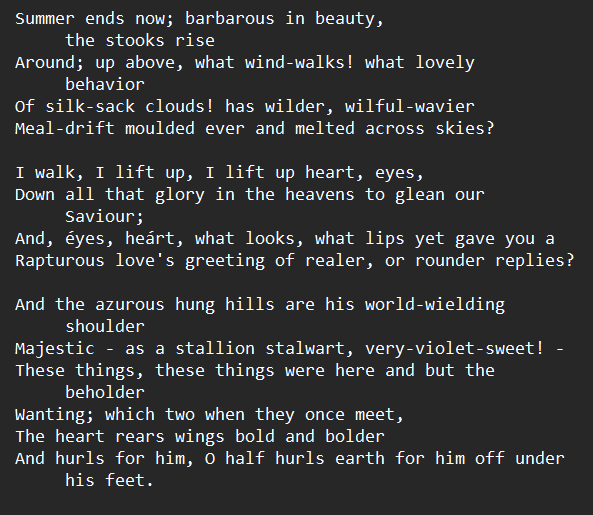
Hopkins, Gerard Manley. Hopkins: Poems (Everyman’s Library Pocket Poets Series) London: Everyman’s Library, 1995.
About four days from the enchanted stream they came to a part where most of the trees were beeches. They were at first inclined to be cheered by the change, for here there was no undergrowth and the shadow was not so deep. There was a greenish light about them, and in places they could see some distance to either side of the path. Yet the light only showed them endless lines of straight grey trunks like the pillars of some huge twilight hall. There was a breath of air and a noise of wind, but had a sad sound. A few leaves came rustling down to remind them that outside was coming on. Their feet ruffled among the dead leaves of countless other autumns that drifted over the banks of the path from the deep red carpets of the forest.
Tolkien, J.R.R.. The Hobbit or There and Back Again. New York: Houghton Mifflin Company, 1997. (See pages 128,129)
We’ll let Mr. Baggins, Beorn, Thorin, Fili, Balin, Ori, Nori, Bifur, Bofur, Gloin, Dori, and bumbling Bombur usher us into fall.
From Friends Divided: John Adams and Thomas Jefferson.
Two solid paragraphs from Gordon S. Wood on Thomas Jefferson’s endless curiosity.
He was interested in more things and knew about more things than any other American. When he was abroad he traveled to more varied places in Europe than Adam’s ever did, and kept a detailed record of all that he had seen, especially of the many vineyards he visited.
Wood, Gordon S. Friends Divided: John Adams and Thomas Jefferson. New York: Penguin Press, 2017. pg. 10
Not sure how one measures that Jefferson was interested in more things, and knew more things than any other American, but I trust Mr. Wood here. Also, Jefferson’s record keeping is legendary.
He amassed nearly seven thousand books and consulted them constantly; he wanted both his library and his mind to embrace virtually all of human knowledge, and he came as close to that embrace as an eighteenth century American could. Every aspect of natural history and science fascinated him.
Wood, Gordon S. Friends Divided: John Adams and Thomas Jefferson. New York: Penguin Press, 2017. pg. 10, 11
It wasn’t enough that Thomas Jefferson owned seven thousand books. He consulted them regularly.
He knew about flowers, plants, birds, and animals, and he had a passion for all facets of agriculture. He had a fascination for meteorology, archaeology, and the origins of the American Indians. He loved mathematics and sought to apply mathematical principles to almost everything, from coinage and weights and measures to the frequency of rebellions and the length of people’s lives. He was an inveterate tinkerer and inventor and was constantly thinking of newer and better ways of doing things, whether it was plowing, the copying of handwriting, or measuring distances.
Wood, Gordon S. Friends Divided: John Adams and Thomas Jefferson. New York: Penguin Press, 2017. pg. 11
It’s hard to think of any modern, public person, with Jefferson’s insatiable appetite for “all of human knowledge”.
What draws us to the fictional characters? There’s so much really. How the character is introduced. How they speak. Their perfections. Their flaws.
In Rooftoppers, author Katherine Rundell introduces us to Charles Maxim. He is Sophie’s ward.
Charles is not a smiler. He is not a skipping and kicking your heels with joy type of man. He eats and sleeps little but is somehow not cranky. He is kind. He is generous. He is quotable.
Curiously, Katherine Rundell introduces Charles to us multiple times with different methods. The first intro is a third person introduction:
Charles ate little, and slept rarely, and he did not smile as often as other people. But he had kindness where other people had lungs, and politeness in his fingertips.
Rundell, Katherine. Rooftoppers. New York: Simon & Schuster Books for Young Readers, 2013, pg 11
Then through his character assessment file at the National Childcare Agency:
“C.P. Maxim is bookish, as one would expect of a scholar-also apparently generous, awkward, industrious. He is unusually tall, but doctors’ reports suggest he is otherwise healthy. He is stubbornly certain of his ability to care for a female ward.”
Rundell, Katherine. Rooftoppers. New York: Simon & Schuster Books for Young Readers, 2013, pg 8
Clever approach that. Reinforces who Charles Maxim is without boring us. Katherine Rundell doesn’t create balsa wood characters.
Ok, onto the quotes.
Aptly named, a Charles Maxim quote book should exist. Here’s a few to take home with you.
On parenting:
“I am sure the secrets of child care, dark and mysterious though they no doubt are, are not impenetrable.”
On books:
“Books crowbar the the world open for you.”
On eating ice cream:
“I have a theory” he said, “That the the best place to eat ice cream is in the rain on the outside box of a four-horse carriage.”
On the importance of umbrellas:
“I am an Englishman. I always have an umbrella. I would no more go out without my umbrella than I would leave the house without my small intestine.”
On life:
Never ignore a possible!
Pick up Rooftoppers from somewhere!
John Adams kept a journal. Spared no thought or criticism. Emotions splattered on the page:
Keeping as full and honest a diary as he did was part of the inheritance passed on from his Puritan ancestors; but it was also an inevitable response to his acute self-awareness. None of his colleagues and in fact no American in the eighteenth century kept a diary like that of Adams. In it he poured out all his feelings — all his anxieties and ambitions, all his jealousies and resentments.
Friends Divided: John Adams and Thomas Jefferson, Chapter One, Contrasts, pg 25. Gordon S. Wood
It takes courage to keep a diary as Adams did. Surely he must’ve known it would be read by the public at some point in time. To record one’s insecurities and shortcomings is therapeutic and brave.
Wood continues:
Adams used his diary to begin a lifelong struggle with what he often considered his unworthy pride and passions. “He is not a wise man and is unfit to fill any important Station in Society, that has left one Passion in his Soul unsubdued.” Like his seventeenth-century Puritan ancestors, he could not have success without guilt.
Friends Divided: John Adams and Thomas Jefferson, Chapter One, Contrasts, pg 25, 26. Gordon S. Wood
John Adams was TMI. Thomas Jefferson stayed mysterious:
It is impossible to imagine Jefferson writing such a journal. Jefferson was always reserved and self possessed and, unlike Adams, he scarcely ever revealed much of his inner self. Jefferson seemed to open up to no one, while Adams at times seemed to open up to everyone. He certainly opened up to his diary. “Honesty, Sincerity, and openness, I esteem essential marks of a good mind,” he wrote, and once he got going his candid entries bore out that judgement.
Friends Divided: John Adams and Thomas Jefferson, Chapter One, Contrasts, pg 25. Gordon S. Wood
Thomas Jefferson in contrast, ditched the diary. He recorded facts:
Jefferson kept no diary, and if he had, he would never have expressed any self-loathing in it. Instead of a diary, Jefferson kept records — records, it seems, of everything, with what he called “scrupulous fidelity.” He religiously recorded the weather, taking the temperature twice a day, once in the morning and again at four in the afternoon. He entered into memorandum books every financial transaction, every source of income and every expenditure, no matter how small or how large — seven pennies for chickens or thousands of dollars for a land sale.
Friends Divided: John Adams and Thomas Jefferson, pg 27. Gordon S. Wood
No surprise then Thomas Jefferson kept an array of commonplace books:
He kept a variety of specialized books, including several commonplace books — a legal book, an equity book, and a literary book, in which he copied passages from his reading that he found important or interesting. He also kept a case book and a fee book, for tracking work and income from his legal career as long as it lasted; a farm book, in which he entered, among other things, the births and sales of slaves as well as farm animals; and a garden book. In his garden book, he made such notations as how many peas he was planting would fill a pint measure, how much fodder a horse would eat in a night, and how many cucumbers fifty hills would yield in a season.
Friends Divided: John Adams and Thomas Jefferson, pg 27. Gordon S. Wood
Fascinating how John Adams and Thomas Jefferson’s personalities were reflected in their daily writing habits. The pugnacious Adams’ confessionals, and Jefferson’s facts only approach.
From Gordon S. Wood‘s book: Friends Divided: John Adams and Thomas Jefferson
Whenever it’s bad weather, I draw at home and lend a hand to raise my little boys. They will never know what we are doing to give them everything they need.
The Sea Journal: Seafarers’ Sketchbooks, edited by Huw Lewis-Jones, pg 192
Paul-Émile Pajot sharing some life secrets.
Work.
Draw.
Help out with the kids.
I listened to The Love Movement longingly on a school bus in the early fall in Ohio, where the leaves began to fight against their inevitable departure. By the tree that hung over my bus stop, the leaves slowly began to gather around the tree’s base, as if to say We did our best. We’ll try again next time.
Go Ahead in the Rain, The Source Cover
Autumn in literature rolls into Monday.
Hanif Abdurraqib reminisces on listening to A Tribe Called Quest’s The Love Moment in the fall of 98.
 Floodlights and Goalposts