Montaigne loved open debate. “No propositions astonish me, no belief offends me, whatever contrast it offers with my own.” He like being contradicted, as it opened up more interesting conversations and helped him to think–something he preferred to do through interaction rather than staring into the fire like Descartes. His friend Florimond de Raemond described his conversation as “the sweetest and most enriched with graces.” Yet when Montaigne was not feeling sweet, or when he was carried away by the topic of discussion, he could be vociferous. His passion led him to say things that were indiscreet, and he encouraged others to do the same.
Bakewell, Sarah. How to Live: Or A Life of Montaigne in One Question and Twenty Attempts at an Answer. New York: Other Press, 2011 pp170.
-
-
What if across your lifetime, you could only choose one book to read?
You can only read so many books in a lifetime. I mean, part of me thinks we’d be better off picking one book and never reading another book, and just getting through that one book very well.
The Cultural Tutor. 48:46Which book would you choose?
For readers, it would be challenging to only read one. Dipping in and out of books is proven method for determining what to read. But the idea of rereading for a deeper understanding is invaluable.
See philosopher/entrepreneur Johnathan Bi‘s careful reading approach:
-
Despite setbacks, he kept reading, writing, and cataloging.
Sometimes we don’t even know we’re preparing for our big project. At this point in J.A. Baker’s life he was back in Chelmsford, unemployed. But…
He was not disheartened. As far as he was concerned his real work was going very well: in the three months between returning from Roffey and starting work in London he had read almost sixty books; such ‘aesthetic stimulus’, as he called it, was far more important to his long term goals. Now that he had time on his hands, he was keen to devote it to his literary projects. Days and nights were spent feverishly reading and writing.
He built up his personal library. Something he’d continue to do through his lifetime:
By the end of January 1946, Baker’s library had grown to remarkable levels. Dozens of books of poetry had been consumed as he made his way through the canonical writers of the nineteenth century, including Walt Whitman, Gerard Manley Hopkins and Robert Browning (as well as translations of the French and German poets Rimbaud and Rilke), and moved on to modern writers: John Masefield, T.S. Eliot (whom he had grown to like, despite not having been offered a job at Faber), Cecil Day Lewis and Stephen Spender. He discovered a love for the lilting style of the ‘ultra-modern’ Dylan Thomas, whom he thought perfectly mirrored his own memories of childhood and love of the countryside.
and Baker practiced his writerley scales:
Exercise books were filled with notes on form and metre, and hundreds of poems carefully copied out. Study was an outlet: it helped him to stave off bouts of depression that continued to threaten.
Saunders, Hetty. My House of Sky: The life and work of J.A. Baker. Lower Dairy, Toller Fratrum, Dorset: Little Toller Books, 2017.
-
Shasta cried only a very little; he was used to hard knocks.
Lewis. C.S.. The Horse and His Boy. New York: Harper Collins, 2002.Annie. Jay-Z. C.S. Lewis. The phrase “hard-knocks” has been around since 1870.
-
Baker wasn’t just bird watching
E.M. Nicholson‘s book The Art of Bird Watching recommends keeping a card system to document bird sightings:
Along with the field notes (which, according to Nicholson, had to be made in the field within the first few minutes of the sighting), Nicholson also advised his readers to make another, more detailed and permanent record. This, he said, should be something like a card system, and most certainly, ‘not a record in diary form which’, he remarked, ‘soon becomes unmanageable.’
Baker ignored this. He took up the diary form. Which makes sense considering Baker’s literary tendencies:
Yet a record in diary form was exactly what Baker chose to write when he started his ‘systematic watching’. At the end of each outing he would come home and write up the day’s field notes into the exercise books he kept in the spare bedroom which he had converted into his study. Here he kept other kinds of birding notes that also went beyond Nicholson’s remit of a useful permanent record. Sometimes these included flowers or feathers that he had brought home, often for Doreen but also for himself as tokens of the day’s expedition and inspiration for his writing.
and
He kept cardboard folders, too, for his other natural history research, on the covers of which he wrote lists of suggested contents. One read: ‘Speculations / Introductions / Valley / Topography / Geology / History / Species Occurring / Peregrine in Essex / Essex Generally / Arrival & Choice of Territory … ‘ ‘ Unmanageable’ might have been Nicholson’s description – and perhaps this was just part of Baker’s unmanageable nature – but in any case Baker seemed to manage it quite well.
I have the suspicion Baker enjoyed this ‘unmanageable’ process. All the detail and time it demanded likely helped him absorb the information even deeper.
Discover your own process. What’s unmanageable to some, could be your ideal.
Saunders, Hetty. My House of Sky: The life and work of J.A. Baker. Lower Dairy, Toller Fratrum, Dorset: Little Toller Books, 2017.
-
A poem for the autumnal equinox.
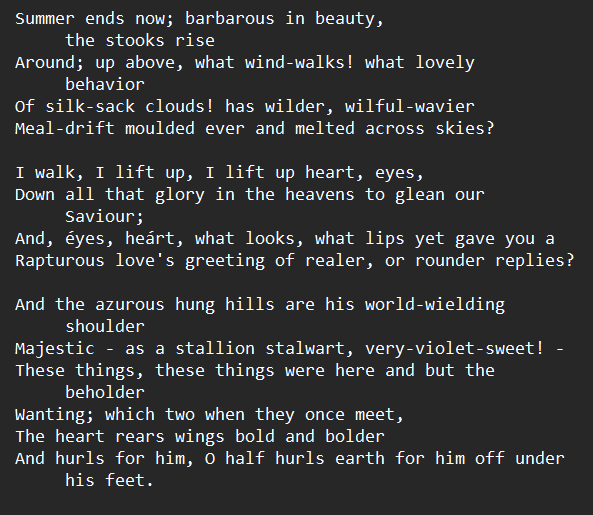
Hopkins, Gerard Manley. Hopkins: Poems (Everyman’s Library Pocket Poets Series) London: Everyman’s Library, 1995.
-
Beer incentivizes science.
From Will O’Brien’s piece in the Fitzwilliam
Taken over its entire history, Guinness may just be the most successful company Ireland has ever produced. In 1930, it was the seventh largest company in Britain or Ireland. It is one of our oldest companies of note. Considering that it predates the Bank of Ireland and the State itself, it could even be said that Guinness is the longest-running successful large institution in Ireland.
Will O’BrienThe Irish brewing company has relentlessly innovated on multiple fronts.
- Workplace benefits
- Annual leave
- Free meals (today would be a company cafeteria)
- Family trips
- Healthcare
- Pension
- Housing!
- The creation of a Guinness Research Laboratory
- The Easy pour system (1959) – Invented by mathematician Michael Ash. Allowed lesser skilled bartenders to serve a quality pour.
- Project ACORN (1969) – Advanced. Cans. of. Rich. Nectar. The first attempt to improve the can or bottle pour.
- “widget” – a gas filled, tennis table sized ball at the bottom of the can that releases a gas that creates bubbles. This greatly improved the taste of home-served pints.
- Branding – Guinness is good for you, Guinness is bad for you, The Guinness Book of Records, producing a Nigerian action film.
Guinness is proof that companies who endure, innovate across multiple areas of their business over an extended timeline. Innovation doesn’t pause.
A must read piece if you’re interested in history, economics, marketing, or beer.
- Workplace benefits
-
More from the
twitterX isn’t all terrible files
So much in one tweet.
Inspiring. Picture Fermat coming home from the office and working on maths after dinner, for fun. What’s your after dinner fun?
Interesting how ambition can fluctuate between people, but success occur. Colossal Descartes. Modest hobbyist Pierre de Fermat. Both with immense contributions to mathematics. Descartes inventing analytic geometry, and Fermat the “founder” of the modern theory of numbers.
How does a lawyer from Toulouse go on to be what Britannica calls “one of the two leading mathematicians of the first half of the 17th century“?
(Boyer, Carl B.. “Pierre de Fermat”. Encyclopedia Britannica, Invalid Date, https://www.britannica.com/biography/Pierre-de-Fermat. Accessed 19 September 2023.)
h/t @netcapgirl
-
Only Herzog could denounce being an artist and simultaneously make himself more of an artist.
Are you an artist?
Never. All I’ve ever wanted to be is a foot soldier of cinema. My films aren’t art. In fact, I’m ambivalent about the very concept of “the artist” It just doesn’t feel right to me. King Farouk of Egypt, in exile and completely obese, wolfing down one leg of lamb after another, said something beautiful: “There are no kings left in the world any more, with the exception of four: the King of Hearts, the King of Diamonds, the King of Spades and the King of Clubs.” Just as the notion of royalty is meaningless today, the concept of being an artist is also somehow outdated. There is only one place left where you find such people: the circus, with its trapeze artists, jugglers, even hunger artists. Equally suspicious to me is the concept of “genius,” which has no place in contemporary society. It belongs to centuries gone by, the eras of pistol duels at dawn and damsels in distress fainting onto chaises longues.
Cronin, Paul. Werner Herzog – A Guide for the Perplexed. London: Faber & Faber, 2020. pp147Herzog also claims his films are poetry, not art. And prefers a craftsman’s approach:
What are your films, if not art?
Poetry. I’m a craftsman, and feel closest to the late-mediaeval artisans who produced their work anonymously – like the master who created the Köln triptych – and never considered themselves artists. To remain anonymous behind what you have created means the work has a stronger life of it’s own, though today, in our increasingly connected world, it’s an illusion to think you can remain hidden. Along with their apprentices, artisans had a genuine understanding of and feeling for the physical materials they worked with. Every sculptor before Michelangelo considered himself a stonemason; no one thought of himself as an artist until maybe the late fifteenth century. Before that they were master craftsmen with apprentices who produced work on commission for popes or Burgermeisters. Once, after snow had fallen in Florence, a particularly idiotic member of the Medici family asked Michelangelo to build a snowman in the courtyard of the family villa. He had no qualms about stepping outside, without a word, and completing this task. I like this attitude of absolute defiance.
Cronin, Paul. Werner Herzog – A Guide for the Perplexed. London: Faber & Faber, 2020. pp147I wonder if Herzog’s claim that no one considered themselves artists until around the late 15th century is true.
If true, what triggered the change?
Was it more wealth, allowing master craftsman to create “art” in their spare time?
Was it the availability of materials? Did “art” supplies increase in abundance around the 15 century?
Werner Herzog – A Guide for the Perplexed is the modern day Hitchcock by Truffaut.
 Floodlights and Goalposts