Graphite memories.
HB pencil, contour lines.
Loyal companion.
An online commonplace book
Graphite memories.
HB pencil, contour lines.
Loyal companion.
Hennepin Chinos
flat, fresh. Iron steam rises.
Monday doesn’t wait.
Five a.m. egg yolks.
Meat locker hooks, left jabs bring
tears for Adrian.
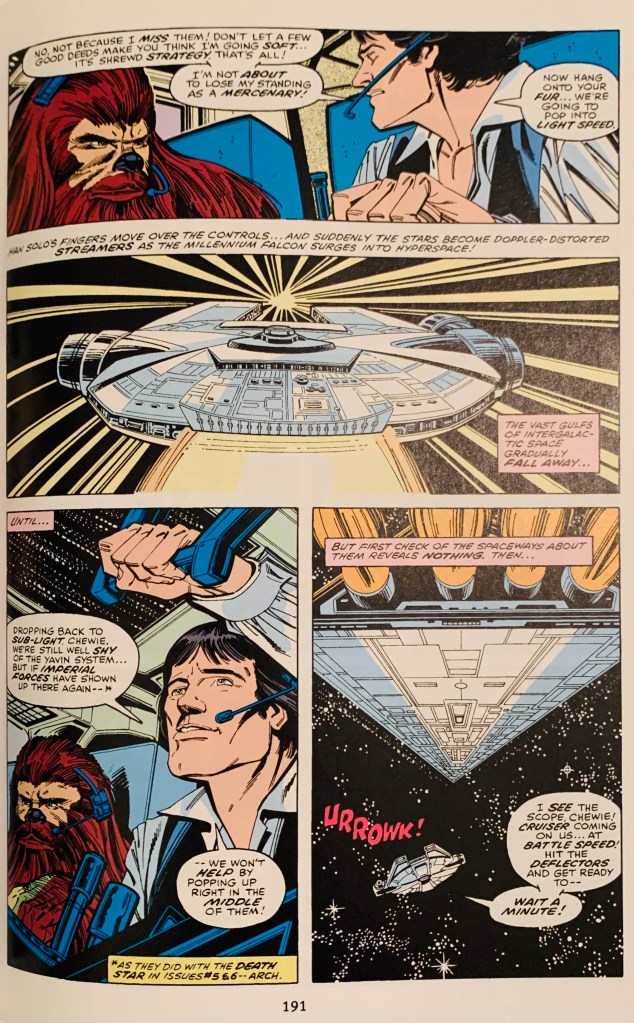
Long before Disney owned Marvel Comics and Star Wars, Marvel Comics Group held the publishing rights to Star Wars comics.
Then shit got weird – for Han Solo in particular.
In this expanded universe Han meets a space rabbit named Jaxxon, wields a light sabre, teams up with a man dressed up in a Chewbacca Halloween costume, and rescues a bald librarian Jedi wannabe named Don-Wan from an intergalactic dinosaur.
Like we said. Shit got weird.
The Knicks were my first.
Before Shaq. Before Penny.
Madison Square love.
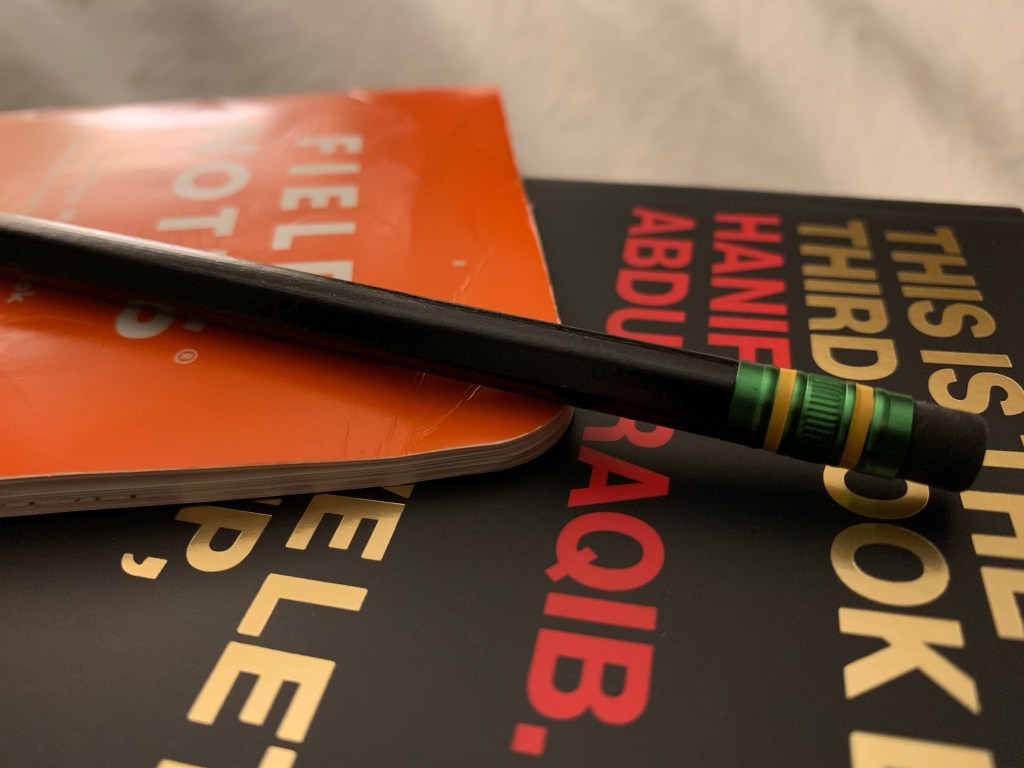
A Field Notes pad will make you brave as Ernest Shackleton.
A Ticonderoga pencil will make you write like Dickens.
Get some.
When laid out this way, it would appear that the art of the sample, in the mind of Q-Tip, was science. He began by laying out pause tapes in his home until 1989, when he had the opportunity to be present for the recording of De La Soul’s iconic album Three Feet High and Rising. It was in those moments when he was shown around the studio by the in-house recording engineers and afterward was allowed to tinker with all the sampling devices. Seeing his potential and interest, the rapper and producer Large Professor taught him how to use other studio equipment to most effectively hone his sound. Not all young producers have a group of welcoming mentors like Q-Tip had, but not all young producers were as uniquely skilled from their teenage years as Q-tip was, and not all were as willing as Q-Tip to “dig deep in the crates” to search for sounds. Q-Tip was, in many ways, an extension of rap’s early DJs, chipping away at a massive block of music and peeling off only what he needed.
Go Ahead in The Rain: Notes to a Tribe Called Quest, pg.26
THIS BOOK! THIS DUDE!
Hanif’s words giving us the viewfinder close-up of Q-Tip’s musical development.
To release some of his jumpy energy and his mind’s ceaseless inventorying and inquisitiveness, Thurber drew. It was as habitual as his smoking. Writing-rewriting, as he often called it- required discipline, focus, research, an amped-up armature of full brain power that included memory, grammar, word and sentence sounds, a dialing in of the humorous of and the heartfelt, the meandering and the meaningful. But drawings? He considered his to be fluid, spontaneous, unhindered, and with rarely a need for erasure, revision, or polish. His daughter Rosemary remembers her father saying that he could even whistle while he drew.
A Mile and a Half of Lines: The Art of James Thurber, by Michael J. Rosen
If you’re looking for some artistic inspiration, or need to smile, pick up A Mile and a Half of Lines. After skimming through five or ten pages you’ll be feening to pick up a pencil and draw.
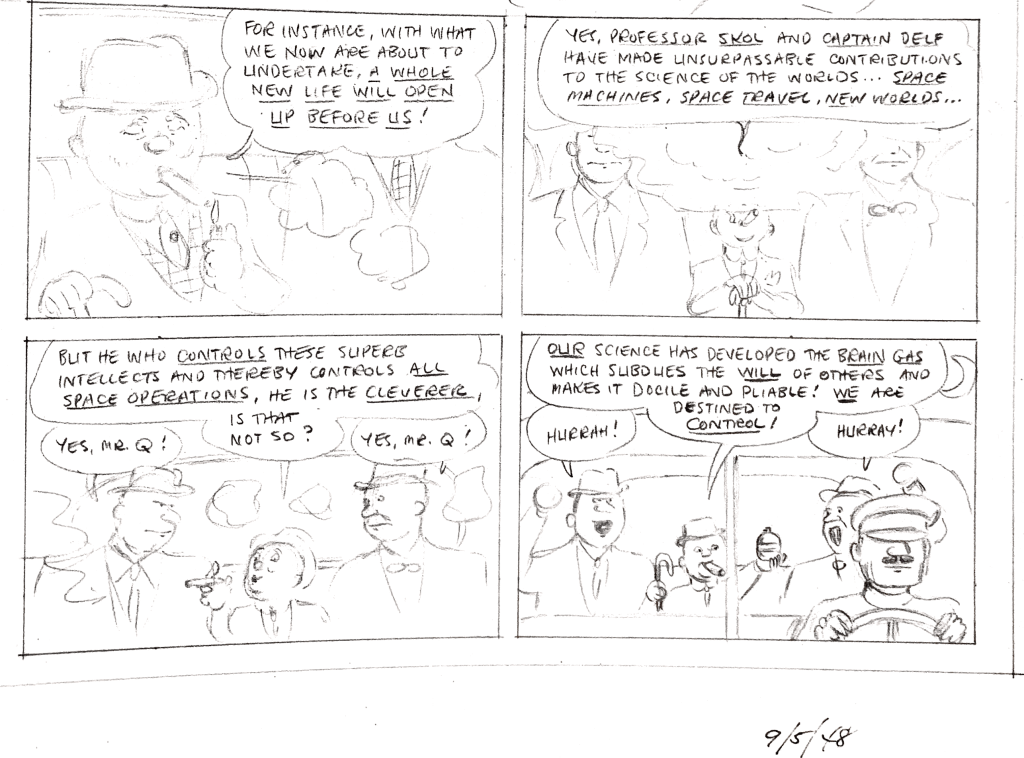
A Four Panel Friday first – layouts instead of completed work. This from an unpublished Spirit story titled: The Cigar.
Important note – Klaus Nordling drew these layouts, not Will Eisner.
Good example of solid panel framing here. Nordling goes from a relative close up of Mr. Q, to framing him between the two henchman. Sweet stache’ on the driver too.
From: Will Eisner: Champion of the Graphic Novel
By: Paul Levitz
January’s winds are merciless, splitting open dry knuckles with blood slivers. 9-to-5ers power-walk the final two blocks to their warm cubicles and electric standing desks.
A few trees down from the office, in-front of Heavy Burger, a strange collection of city trash lies. A toppled lime electric scooter, neck twisted, lays between the road and the side walk. An aluminum silver Baby Ruth candy bar wrapper flaps next to the handlebars. And a nylon purple poncho, a size 8 step away from the wrapper, collects rain in its creases.
A frazzled commuter left it all behind.

