
Every now and then you finish something.
An online commonplace book
Every now and then you finish something.

After creating the most viral video game of all time, Alexey Pajitnov went back to work.
From: Tetris: The Games People Play
By: Box Brown
Day fullblown and splendid….day of the immense sun,
and action and ambition and laughter,
The night follows close, with millions of suns, and sleep
and restoring darkness.
Happy Thanksgiving everyone. And thanks for reading!
From: Leaves of Grass 150th Anniversary Edition (Penguin Classics), pg.157
If you live in the western hemisphere, in particular North America, the constellation Orion is depicted as a mighty warrior.
He wears a belt. He holds a sword. He stands heroically.
In Australia though, looking up from the southern hemisphere, Orion’s arrangement in the sky flips upside down. His legend takes on a different meaning.
Heather Couper and Nigel Henbest explain further in their book – The Story of Astronomy: How the universe revealed it’s secrets.
The Constellation of Orion – seen in the West as a mighty hunter – also has a different interpretation in Australia. That’s partly because the stars are seen ‘upside down’ from the southern hemisphere. Contemporary Australians often pick out the central three stars of Orion’s ‘Belt’ and ‘Sword’ as a rather nicely defined Saucepan!
‘The Yolngu see the three stars of Orion’s Belt as three men sitting in a canoe,’ says Ray Norris, returning to the more ancient traditions, ‘with Betelgeuse and Rigel as the front and back of the canoe.’ Orion’s Sword – comprising fainter stars and the glowing patch of the Orion Nebula – is a fish caught on a fishing line. Norris enthuses: ‘Once you’ve been told this, and you’ve seen it, its actually really dramatic.’
Three men sitting in a canoe. A saucepan. A fish dangling from it’s line.
Switching hemispheres will switch your perspective.
I’ll never look at Orion the same way again.
New life goal: gaze at Orion from the southern hemisphere.
Great is youth, and equally great is old age….great are
the day and night;
Great is wealth and great is poverty….great is
expression and great is silence.
Youth large lusty and loving….youth full of grace and
force and fascination,
Do you know that old age may come after you with equal
grace and force and fascination?
Old age is coming with grace and fascination?
I’m not so sure.
Force?
Yes.
You’re right Walt. Old age is the unstoppable force.
From: Leaves of Grass 150th Anniversary Edition (Penguin Classics), pg.157
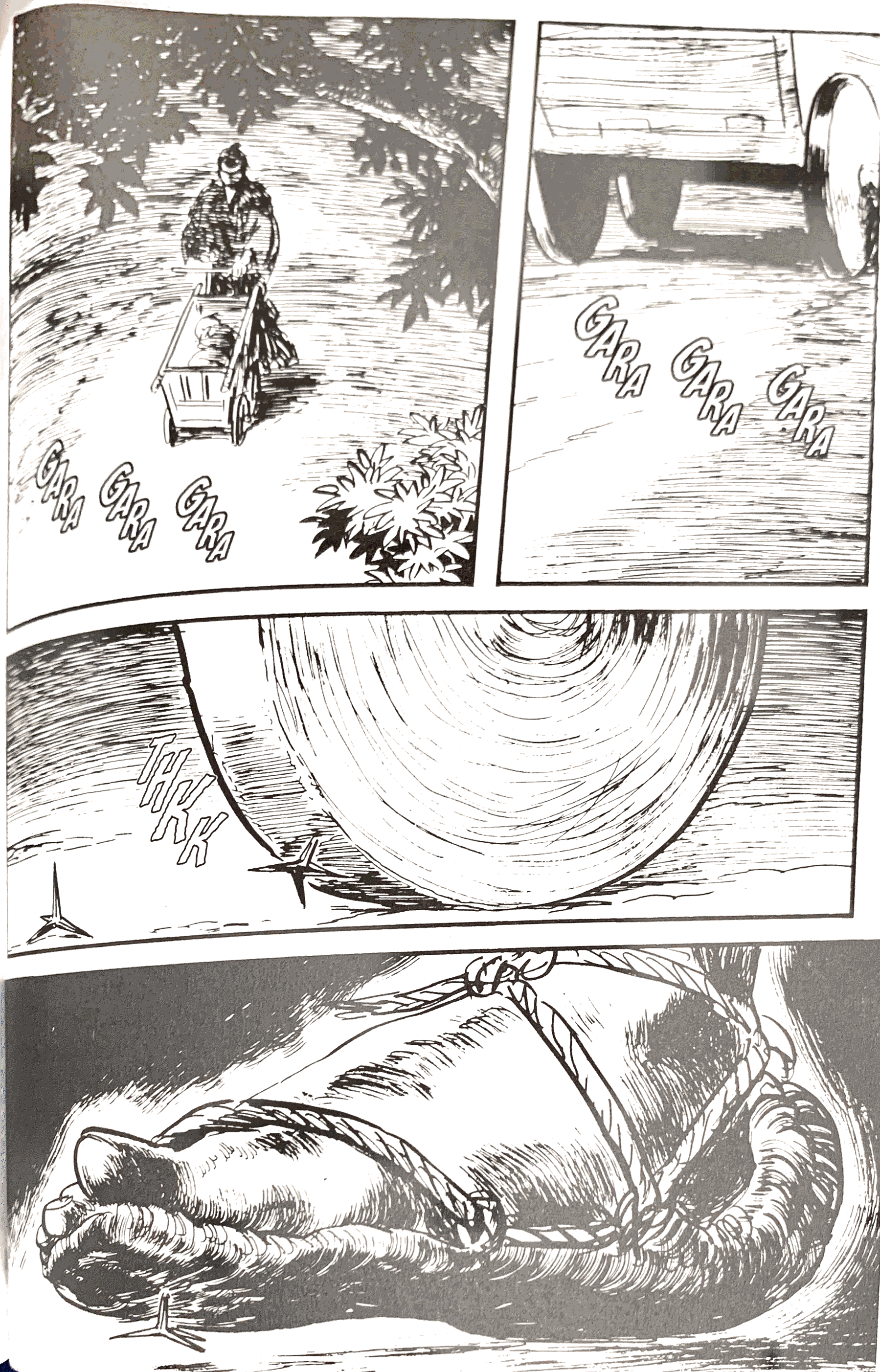
Lone Wolf and Cub is one of those heralded comics I heard a lot about, but never gave a chance.
My early impressions?
Kazuo Koike and Goseki Kojima make every panel matter. Each image has a moment of tension, a build up that nudges the story forward.

I pass this tag everyday. I’m surprised it hasn’t been wiped away yet.
It looks like a motorbike from the future jumping off the past.
There’s no seat. You magnetically hover above the frame.
There’s no handlebars. You steer by telepathy.
Crazy thought?
Yes.
But this is where we’re headed.
Earth tone table cloths
Naked trees, light family feuds
Uncork the cheap wine.
 Floodlights and Goalposts