But readers persist, silently making their way though the great works, keeping unbroken the chain that takes us back, generation by generation, through human history. It is not just scholarship that keeps great texts alive, but the life of the common reader, the silent, unheralded reader, who finds herself unable to complete a bus journey without resorting to her scrawny old copy of Bleak House
Work, to him, is a pleasure, and also a habit. When he moved into his flat on Powis Terrace in 1962, the largest room served as both his bedroom and his studio. On the chest of drawers, he place a notice in large capital letters reading ‘GET UP AND WORK IMMEDIATELY’ (which he did with all the more alacrity since he regretted wasting two hours painting the sign).
– Martin Gayford
One doesn’t need a separate room for a studio. You can make it work. Keep going.
Gayford, Martin, and Hockney, David. Spring Cannot Be Cancelled: David Hockney in Normandy. United Kingdom, Thames & Hudson, 2021. pp76
First appearing in his Essay “On Living in an Atomic Age“. Lewis answers the question – how to live in a time of uncertainty?
Why, as you would have lived in the sixteenth century when the plagued visited London almost every year, or as you would have lived in a Viking age when raiders from Scandinavia might land and cut your throat at night….The first action to take is to pull ourselves together. If we are all going to be destroyed by an atomic bomb, let that bomb come when it comes find us doing sensible and human things—praying, working, teaching, reading, listening to music, bathing the children, playing tennis, chatting to our friends over a pint and a game of darts—not huddled together like frightened sheep and thinking about bombs. They may break our bodies (a microbe can do that) but they need not dominate our minds.
Now learn about velocity; learn how the air makes things twist. Look it up! Learn it! Learn as much as you can, for learning is the very opposite of death! Wonderful!” Grandpa was the only person Vita knew who seemed to spark electricity when he talked, as if he struck against the world like flint against steel.
– Vita’s Grandpa
Rundell, Katherine. The Good Thieves. New York: Simon & Schuster Books for Young Readers, 2019 (see page 13)
Each Katherine Rundell book contains hidden bits of advice. As the new year approaches, remember, so much of learning is found in looking things up.
Here Professor Jacobs presents reading on a Whim. The idea that one should read what interests them, rather than what “you’re supposed to”.
Professor Jacobs argues reading shouldn’t be a chore, but rather a pleasurable experience.
You don’t have to read according to an assignment or according to a list of approved texts. Enjoy your freedom. Go out there and follow your whim. And by that, I mean follow that which really draws your spirit and your soul and see where that takes you. If it turns out that you spend a year reading Stephen King novels or something like that, that’s totally fine. That’s not a problem. Read your Stephen King novels, but there are also really good novels.
But whatever it happens to be, if you’re reading young adult fiction for a year, read young adult fiction for a year. After a while, you probably got to have enough of that. But don’t go around making your reading life a kind of means of authenticating yourself as a serious person. It’s just no way to live. So, I would always tell them, “Give yourself a break. Don’t make a list. See where Whim takes you.”
This book took 5 years to finish, not because Sacks’ memoir isn’t compulsively readable, but because there were other books I thought I should read instead.
Sack’s life is one to emulate. Not by becoming a neurologist and cultivating a British Accent. But rather by seeing life, all of life – love, career, hobbies travel, failure, success, as an adventure to pursue.
At one time, my father had thought of a career in neurology but then decided that general practice would be “more real,” “more fun,” because it would bring him into deeper contact with people and their lives.
This intense human interest he preserved to the last: when he reached the age of ninety, David and I entreated him to retire-or at least, to stop his house calls. He replied that home visits were “the heart” of medical practice and that he would sooner stop anything else. From the age of ninety to almost ninety-four, he would charter a mini-cap for the day to continue house calls.
Dan Wang’s article on Philip Glass’ memoir –Words Without Music was inspiring.
Learning that Glass drove taxis, and was a self-taught plumber proves there’s no shame in taking day jobs to support one’s calling.
Learning that Glass didn’t succeed as a full time composer until his forties served as a reminder.
Stamina can take one to the impossible.
Glass didn’t work just as a taxi driver and as a (self-taught) plumber. He also worked in a steel factory, as a gallery assistant, and as a furniture mover. He continued doing these jobs until the age of 41, when a commission from the Netherlands Opera decisively freed him from having to drive taxis. Just in time, too, as he describes an instance when he came worryingly close to being murdered in his own cab.
I thank the musicians who brought us so much joy in difficult times—often with few immediate rewards beyond those music itself brings. It made a difference.
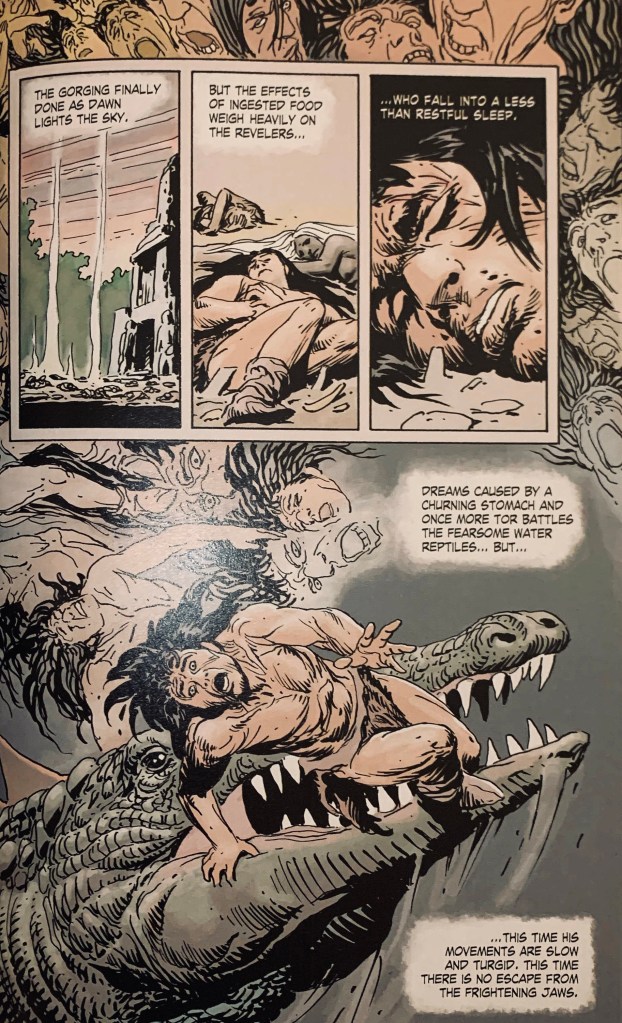
The late Joe Kubert was one of the finest comic book artists of his generation. He was also an underrated paleo-artist.
TOR – A Prehistoric Odyssey unleashes Joe’s paleo-chops. The panels are filled to the brim with not only Dinosaurs, but Sabre-tooth tigers, giant squids, prehistoric alligators, and yeti as well.
 Floodlights and Goalposts