- What type of poem is it?
- What is its mode? Lyric, narrative, dramatic?
- What is the form?
- Does it have meter? Does it have rhyme? Is it in free verse?
- What is the diction or vocabulary of the poem?
- Who is the speaker of the poem?
- Is there a story line or action?
- What is the setting?
- What are the images?
- Are there figures of speech?
- Are there any allusions in the poem?
- What’s the tone?
- Does the poem have any symbols?
Tag: craft
-
-
MZS: How do you work out ideas for costumes before they’re sewn? Do you draw rough versions of them in a sketchbook and then have somebody do more elaborate illustrations when the ideas have settled a bit?
MC: On the other two movies I did with Wes, The Life Aquatic and the Darjeeling Limited, I applied traditional sketching methods to design the look of the characters. On this one, our illustrators used both Photoshop and traditional sketching to incorporate Wes’s and my own ideas. With Photoshop we could get very close to the actors’ likenesses, and then easily do variations and send them to Wes via e-mail. The actors were very pleased because they could relate easily to how their character would look. Having worked on two of Wes’s other movies, I had already worked with some of his “ensemble” actors and it was interesting to change them again to these other characters. Wes had decided that all the men in the movie would have moustaches or beards, save for Jopling and the nasty sergeant in the train. I loved this idea, and it is curios that hardly anyone notices this detail–but it gives a style to the men’s looks.
Zoller Seitz, Matt. The Wes Anderson Collection: The Grand Budapest Hotel. New York: Abrams, 2015 (see page 89)Costume design is an overlooked art form. When done well it’s hardly noticed, but adds to the world as a character. The 2017 American film Lady Bird is an excellent example. Anyone who grew up in 90s suburban America will recognize that movie and say yes! Yes! That’s exactly how a pre-teen leaving mass would dress 30 years ago.
-
“By the 1950s I had found I was frightened when giving public talks to large audiences, this in spite of having taught classes in college for many years. On thinking this over very seriously, I came to the conclusion I could not afford to be crippled that way and still become a great scientist; the duty of a scientist is not only to find new things, but to communicate them successfully in at least three forms:
- Writing papers and books
- Prepared public talks
- Impromptu talks
Lacking any one of these would be a serious drag on my career. How to learn to give public talks without being so afraid was my problem. The answer was obviously by practice, and while other things might help, practice was a necessary thing to do.” – Richard W. Hamming from the The Art of Doing Science and Engineering
The duty of a scientist is not only to research, but to communicate.
What’s our typical image of a scientist? Someone dressed in a white lab coat, hovering over a microscope. A lab assistant near, clipboard in hand (even in 2022). Hidden in the basement of some concrete government cube.
But think of the inspiring scientists of our time: Neil deGrasse Tyson, Bob Bakker, Oliver Sacks, the shark lady Eugenie Clark. They were and are scientists of the public. They shared their ideas on TV, in documentaries, podcasts, and lectures. These scientists were and are able to communicate successfully in at least the first two forms mentioned by Richard W. Hamming. Judging by interviews and their public personas I’m sure they were all capable of form #3 as well.
Mr. Richard W. Hamming’s mindset towards his fear is also worth noting. He could’ve dismissed his trepidation of speaking to large crowds as “something I’m just not wired for”. But he didn’t bury his head in the gravel. He decided practice was the necessary thing to do. Hamming would go on to give one of the preeminent talks on cultivating a scientific career titled – You and Your Research.
-
Copywork has long been an essential practice for writers. Notable practitioners include Jack London, Robert Louis Stevenson, Benjamin Franklin, Hunter S. Thompson, Mary Karr…
But copywork isn’t limited to writers. Composers too, have appreciated the benefits of copywork. In his memoir Words Without Music, Philip Glass shares how copying Gustav Mahler’s scores was vital to his development as a composer:
My second study of the orchestra came through a time-honored practice of the past but not much used today-copying out original scores. In my case I took the Mahler Ninth as my subject and I literally copied it out note for note on full-size orchestra paper. Mahler is famous for being a master of the details of orchestration, and though I didn’t complete the whole work, I learned a lot from the exercise. This is exactly how painters in the past and present study painting – even today, some can be seen in museums making copies of traditional paintings. It works the same way in music. This business of copying from the past is a most powerful tool for training and developing a solid orchestration technique.
Copywork, regardless of the discipline, helps you understand how a “thing” is constructed. A piece of art, music, a car engine, can all be better understood by taking each piece apart and reassembling it in the same manner of its original creator.
-

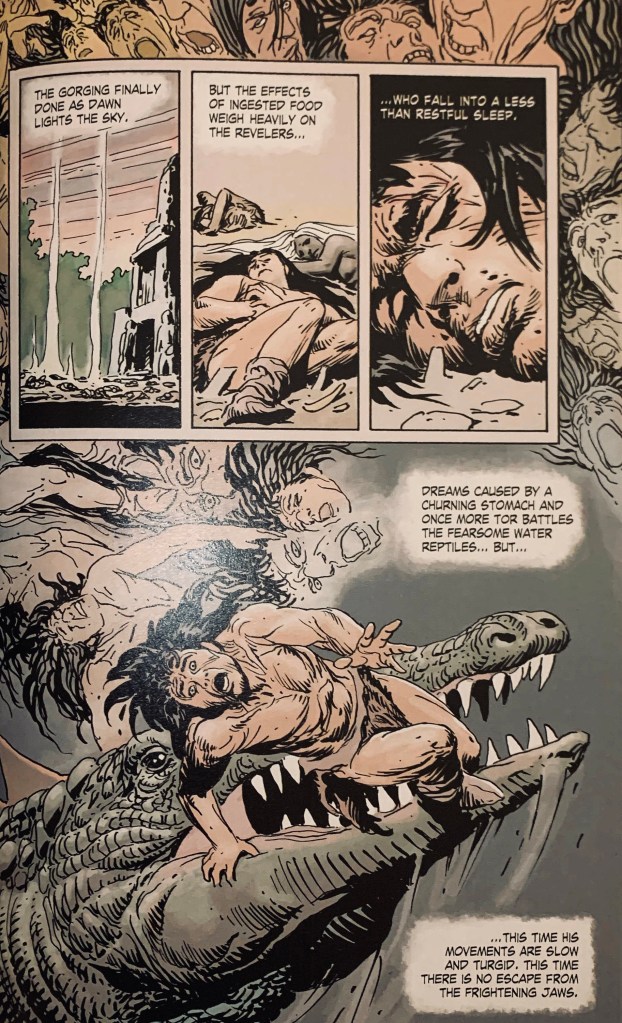
Dream state
The late Joe Kubert was one of the finest comic book artists of his generation. He was also an underrated paleo-artist.
TOR – A Prehistoric Odyssey unleashes Joe’s paleo-chops. The panels are filled to the brim with not only Dinosaurs, but Sabre-tooth tigers, giant squids, prehistoric alligators, and yeti as well.
-

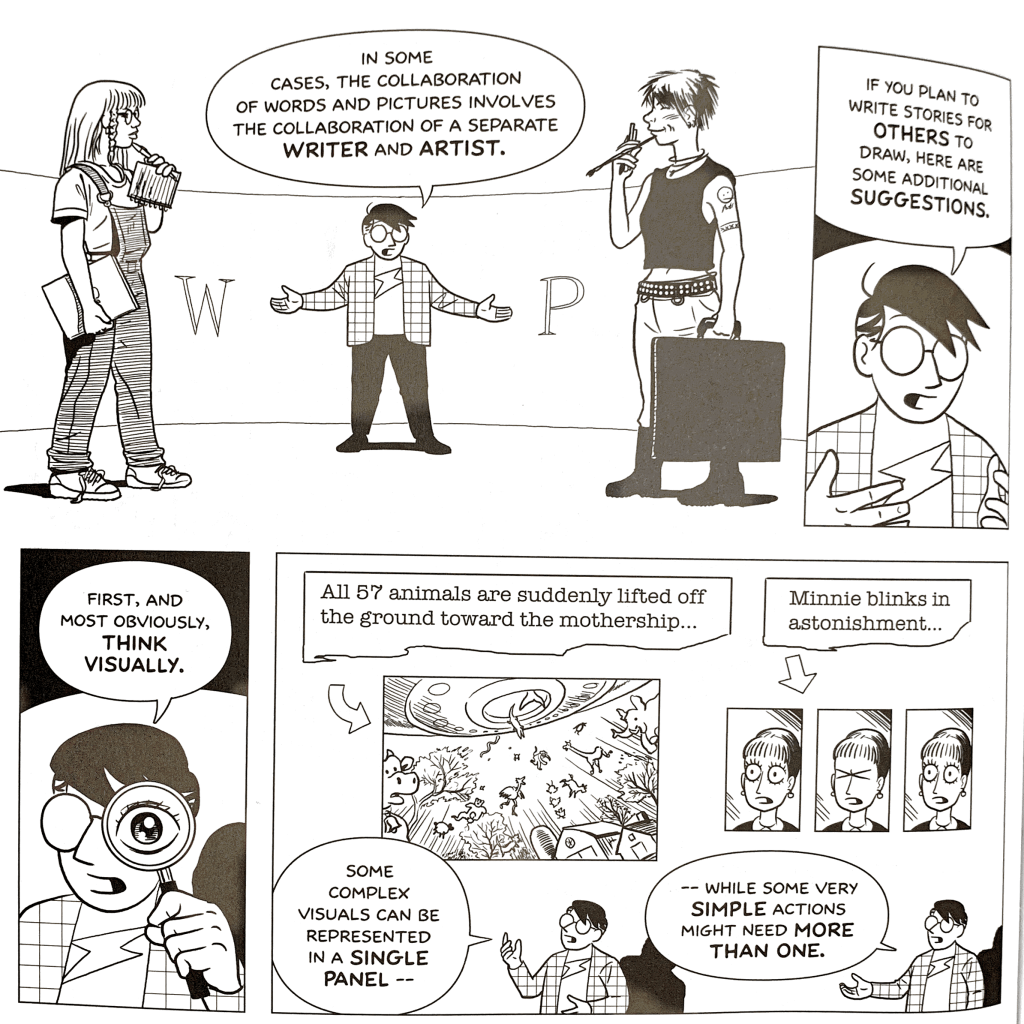
Collabo
There’s plenty of how-to guides for making comics out there. Still, I can’t think of one as comprehensive as Scott McCloud‘s Making Comics.
Though first published in 2006, Making Comics: Storytelling Secrets of Comics, Manga, and Graphic Novels holds up. Even chapter 7, The Comics Professional, still shares sage advice to aspiring comic writers and artists alike.