Cary Grant is the urban, sophisticated king of the screwball comedy.
Nancy Meyers
Tag: video
-
-
The grid is relentless…
Francis MorroneSamuel Hughes and Francis Morrone A primer on historic and modern-day Brooklyn. Hopefully we’ll see more episodes soon!
-
Roald Dahl has a rare talent to be able to just invent these stories that have details and ideas in them that stick in people’s minds for decades and decades – that they never forget.
– Wes AndersonThey need to no question, release this collection on Blu-Ray.
-
With the pennant races rumbling on…
Ohtani as proof mythical men did exist:
Ohtani makes me believe that many of the stories of the heroes of old, of Greek myth, or Mesopotamian myth, Arab or African myth, or whatever myth, that such men did walk the earth
– David Bentley HartDamn. Some men have it all. Ohtani is baseball’s George Clooney.
And lets admit it. It’s annoying. He’s tall. And handsome. And suave. And you know, its just, he makes the rest of us feel just slightly less human.
– David Bentley HartAnd Ohtani’s underrated, but awe inspiring skill:
The thing that amazes me most when I’m watching him is not necessarily the massively soaring home runs, or the one hundred and one mile per hour fastball on the corner. It’s actually watching him run the bases, because he does it like a gazelle. He’s moving as fast as some of the fastest runners in the game, but he looks like he’s just taking long, easy, loping strides when he does it. He’ll steal without a slide half the time, because he doesn’t have to slide. He’s an amazing specimen. And happily plays the only game in the world worthy of his skills.
– David Bentley HartI echo that last statement. Once, I watched Ohtani stretch out a double and his helmet flew off while he was running. I couldn’t help but smile. I thought “man this guy is having fun”.
This excerpt begins at 12:40. Watch the interview in full from the C.S. Lewis foundation below.
-
What if across your lifetime, you could only choose one book to read?
You can only read so many books in a lifetime. I mean, part of me thinks we’d be better off picking one book and never reading another book, and just getting through that one book very well.
The Cultural Tutor. 48:46Which book would you choose?
For readers, it would be challenging to only read one. Dipping in and out of books is proven method for determining what to read. But the idea of rereading for a deeper understanding is invaluable.
See philosopher/entrepreneur Johnathan Bi‘s careful reading approach:
-
Every. Word. Matters.
Sami theorizes that Anderson’s fine grained visual style came out of his writing, which is similarly exact. There’s not much room for verbal improvisation in a Wes Anderson picture because the dialogue is written to mirror, complicate, or intensify Anderson’s filmmaking choices. Every ellipsis, comma, colon, semicolon, exclamation point, parenthetical, and period in a line of dialogue complements the camera movements, lighting, visual effects, sound effects, and music. It’s all of a piece. Filmmaking is screenwriting, screenwriting is filmmaking. All is text. The discrete shots are phrases, sentences, or paragraphs within the larger manuscript of the film. Words matter. Punctuation matters. Sentence length matters. The longer more elaborate camera moves in a Wes Anderson picture could be compared to a monologue in the theater, or a run-on sentence in an essay or novel that keeps going and going till it finally stops.
Scripts can be dismissed in terms of how a movie looks visually. We typically think storyboards and dailies communicate the visual direction the filmmaker desires.
But as Sanjay Sami theorizes, the preciseness of Anderson’s scripts, e.g. word choice, punctuation, the location of a colon or exclamation point, all contribute to the look.
Screenwriting is filmmaking. Akira Kurosawa agrees:
-
Wes Anderson’s collaborator unspools the process.
Wes looked at it and said, it’s just not extreme enough. You know, we want a tree house that’s dangerous. That’s the point of this, is that it’s just too much. We wanted to make the whole thing based on a telephone pole that was sunk into the ground. It had to be multiple trees tied together and that’s what you see here is, is one tree tied on to another.
When you’re talking about how we see these sets its really fun to be able to cheat massively, you know and to say well this is the tree house and it’s actually five foot, by four foot, by three foot, when you look at it from the outside. When you look at it from the inside its twenty feet wide and there’s sixteen kids having a conversation in there. There’s no augmentation to this at all. It’s exactly what you see here.
Adam Stockhausen
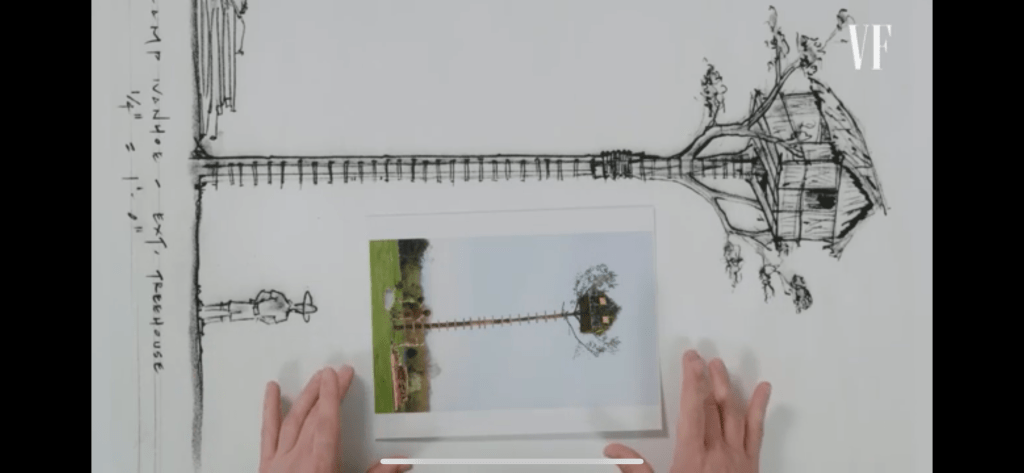
Oh, the lengths you will go…
Great stuff.
-
Not an another Oppenheimer review.
On how the world is organized against mavericks:
Normally the world is organized around dull people. Most power is controlled in this world by people who are straight and narrow. Where as the personal and professional eclectic person like Oppenheimer, the maverick, this kind of person is treated as unsound and is held at a distance. And only at special moments the world seems to be able to use these people.
– Ajay ShahAnd the type of person Oppenheimer would recruit:
When this kind of maverick was brought in to influence and around himself created an organization three thousand or six thousand interesting people, and you can imaging the kind of people who would rally around his recruitment efforts. When he would reach out and make the phone calls to people all over the world, what kind of people would he attract? He would look for the clever ones. He would not look for the obedient ones. And that’s how they did this amazing thing called the Manhattan Project. And then after the war ended the state did not need him and then you got back to the worst instincts of the people who start complaining that oh this guy is unsound in so many ways and do you know “x” about his personal life. And did you know he went and studied Sanskrit, and he takes interest in Hinduism and things like that.
– Ajay Shah -
Tim Hunkin is a professional tinkerer. His YouTube videos series The Secret Life of Components are excellent primers to the hidden lives of machines – their components.
A few notes on chains:
For us engineering noobs, the chain is associated with the bicycle. But oh it’s so much more. Tim Hunkin demonstrates the variety of their uses. Old fashioned arcades. Pulleys. And even a giant metal clock.
Belleville washers are “dished” spring washers. They look a bit like Satellite dishes. These help with torque.
The advent of the “Bush” chain was revolutionary. Bush chains are the modern chain. Their pins are able to slot all the way through the bush. This allows the chain handle greater loads.
They were invented by Hans Renold who founded the Renold Chain Company in 1880. The Renold Chain Company is still in operation.
H/T Kevin Kelly
 Floodlights and Goalposts