“My assistant porter Fritz and I will be serving a small complimentary Christmas brunch, including chocolate flavored hot beverage with whipped topping, in the cafeteria section at the rear of the coach starting in twenty minutes.”
conductor Ralph
Sometimes short films are best. Wes Anderson’s Christmas Movie “Come Together” is short film perfection. It even has a Wikipedia page!
Cohn-Bendit on TV. Intelligent, cunning, devious, has the memory of everything he has ever read; impertinent; good, rapid speaker; wraps up his opponents ( a trio of middle-aged newsmen). He has the ruthlessness of someone unable to put himself in another’s place.
– Mavis Gallant
How does Mavis get away with writing sentences like this? Describing so much with so few words. Incomplete sentences my elementary school teachers would say.
Read a few pages of the Paris Notebook and you’ll realize where the inspiration for the French Dispatch came from. Not only the Lucinda Krementz part. The entire film!
Even the typeface at the top of the pages and chapter beginnings will look familiar.
Gallant, Mavis. Paris Notebooks: Essays & Reviews. United States, David R. Godine Publisher, 2023. p. 19
What was it about May ’68 that made you choose that time as the context of the second story? Is it a product of all the time you’ve spent in Paris? Is there a personal connection?
Mavis Gallant. That was the inspiration. Her experience of May ’68 as a foreigner in Montparnasse: that especially engaged me. Our apartment in Paris is less than a block from where she lived, and I love her descriptions of the neighborhood. I love her voice and her analysis in general: clear, sharp, sometimes even bluntly judgemental – but with deep feeling and understanding. She listens, and her opinions are her own. She sees the young people not how they see themselves, not how their parents see them. She is amused, annoyed, rolls her eyes, and really does love and admire them.
Mavis Gallant was Wes Anderson’s inspiration for Lucinda Krementz in the French Dispatch. Will report back.
Anderson, Wes. The French Dispatch. United Kingdom, Faber & Faber, 2021. pg viii
Roald Dahl has a rare talent to be able to just invent these stories that have details and ideas in them that stick in people’s minds for decades and decades – that they never forget.
– Wes Anderson
They need to no question, release this collection on Blu-Ray.
For the first time in his life he was throwing himself into something with genuine enthusiasm. And the progress he made was remarkable.
pp139
2.
Was it not possible that the process he had gone through in order to acquire yoga powers had completely changed his outlook on life?
Certainly it was possible.
pp154
3.
John Winston told me everything he knew. He showed me the original dark-blue notebook written by Dr. John Cartwright in Bombay in 1934 about Imhrat Khan, and I copied it out word for word.
“Henry always carried it with him,” John Winston said.
“In the end, he knew the whole thing by heart.“
pp168
It could be an early morning thought hallucination, but The Wonderful Life of Henry Sugar suggests the idea that focusing on one thing, over an extended period of time, with sustained enthusiasm, can impact many lives.
What begins as Henry’s single focus then expands to other opportunities. First Henry aims to master concentrating only on the image of his face for five and a half minutes. He masters it. Then he moves to mastering visualizing the reverse side of a playing card within twenty seconds. This then develops to strategic gambling, establishing a non-profit, and leaving behind a clandestine legacy of generosity.
Sami theorizes that Anderson’s fine grained visual style came out of his writing, which is similarly exact. There’s not much room for verbal improvisation in a Wes Anderson picture because the dialogue is written to mirror, complicate, or intensify Anderson’s filmmaking choices. Every ellipsis, comma, colon, semicolon, exclamation point, parenthetical, and period in a line of dialogue complements the camera movements, lighting, visual effects, sound effects, and music. It’s all of a piece. Filmmaking is screenwriting, screenwriting is filmmaking. All is text. The discrete shots are phrases, sentences, or paragraphs within the larger manuscript of the film. Words matter. Punctuation matters. Sentence length matters. The longer more elaborate camera moves in a Wes Anderson picture could be compared to a monologue in the theater, or a run-on sentence in an essay or novel that keeps going and going till it finally stops.
Scripts can be dismissed in terms of how a movie looks visually. We typically think storyboards and dailies communicate the visual direction the filmmaker desires.
But as Sanjay Sami theorizes, the preciseness of Anderson’s scripts, e.g. word choice, punctuation, the location of a colon or exclamation point, all contribute to the look.
Screenwriting is filmmaking. Akira Kurosawa agrees:
Legendary Japanese filmmaker AKIRA KUROSAWA with advice for aspiring writers everywhere. pic.twitter.com/czIHjJD2Kq
— All The Right Movies (@ATRightMovies) July 28, 2023
Stunt men aren’t the only people on set who catch beatdowns
“Wes’s films are the Grip Olympics,” said Sami. “I feel like you need to physically train to work on his movies. But the reward, I think, is comparable to winning a medal at the Olympics. You have the pride of knowing that you’re one of the people that Wes Anderson chose to show up on his set every day and help solve the challenges that he comes up with.”
– Sanjay Sami
Zoller Seitz, Matt. The Wes Anderson Collection: The French Dispatch. New York: Abrams. 2023
You can’t wake up if you don’t fall asleep. I think this is as close as Wes Anderson has ever come to explaining and defending his very peculiar style of filmmaking. What he’s telling us is that the most vital and the most painful things in life cannot be confronted directly, explicitly, artlessly. There must be masks — contrivances, artifice — that distract us, lull us, distract our agitated minds. Tragic experience, to be properly worked through, must wear the mask of comedy. And perhaps for the deepest griefs a single mask is insufficient; you may need several. So here we see layer after layer being peeled away, but no matter how many layers we remove we just find more artifice.
Professor Alan Jacobs’ explanation of Asteroid City is the most considered I’ve read so far. Many puzzled observers want to dismiss it. I was puzzled by it after my first viewing.
Why does does Augie burn his hand on the Quickie Griddle?
What was with the You can’t wake up if you don’t fall asleep chanting at the end?
The flash mob hoedown?
But professor Jacobs seeks to understand what Wes was trying to achieve.
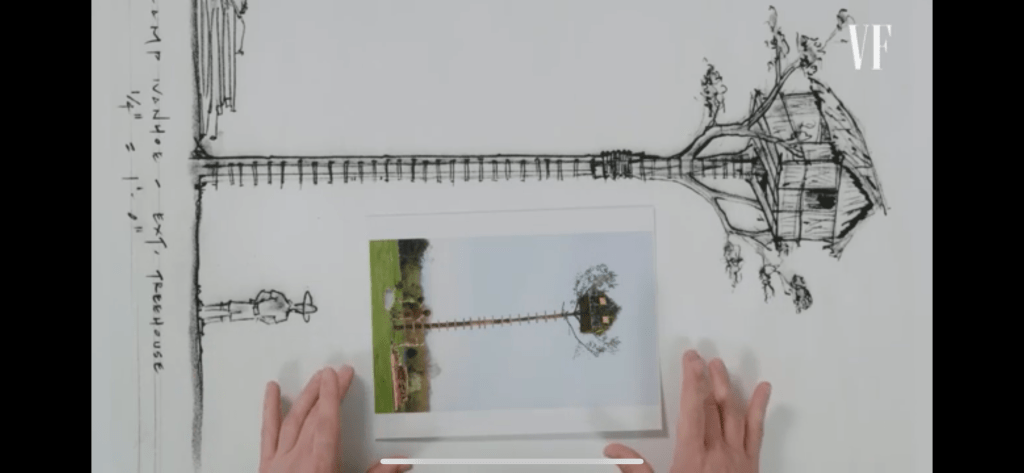
Wes looked at it and said, it’s just not extreme enough. You know, we want a tree house that’s dangerous. That’s the point of this, is that it’s just too much. We wanted to make the whole thing based on a telephone pole that was sunk into the ground. It had to be multiple trees tied together and that’s what you see here is, is one tree tied on to another.
When you’re talking about how we see these sets its really fun to be able to cheat massively, you know and to say well this is the tree house and it’s actually five foot, by four foot, by three foot, when you look at it from the outside. When you look at it from the inside its twenty feet wide and there’s sixteen kids having a conversation in there. There’s no augmentation to this at all. It’s exactly what you see here.
 Floodlights and Goalposts
