Savage Dragon was an idea from Erik Larsen’s youth that grew with him into adulthood.
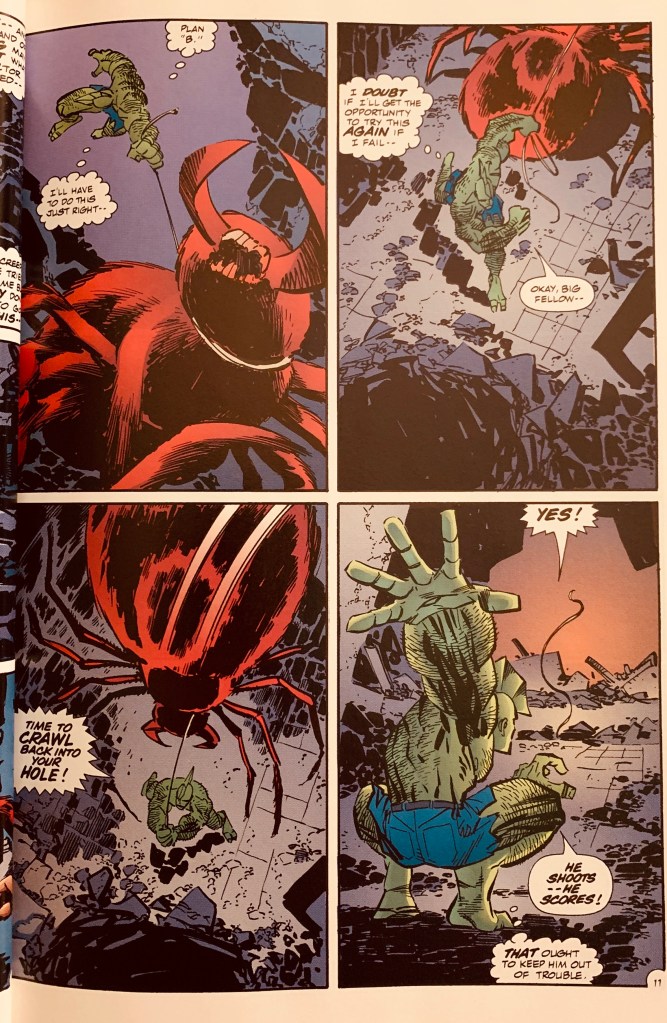
Larsen’s Dragon cracked apart the general superhero story in two ways. (I’m sure there’s more than 2, but for now…)
Savage Dragon is a police officer. The typical super hero trope is a masked gymnast turned vigilante.
Chicago is Dragon’s home. Chicago isn’t as hipster cool as say, Des Moines, Iowa. But it also isn’t New York City, Metropolis, Gotham, Queens or any other NY alias that every other superhero pays crazy rent to live in.
The late Joe Kubert was one of the finest comic book artists of his generation. He was also an underrated paleo-artist.
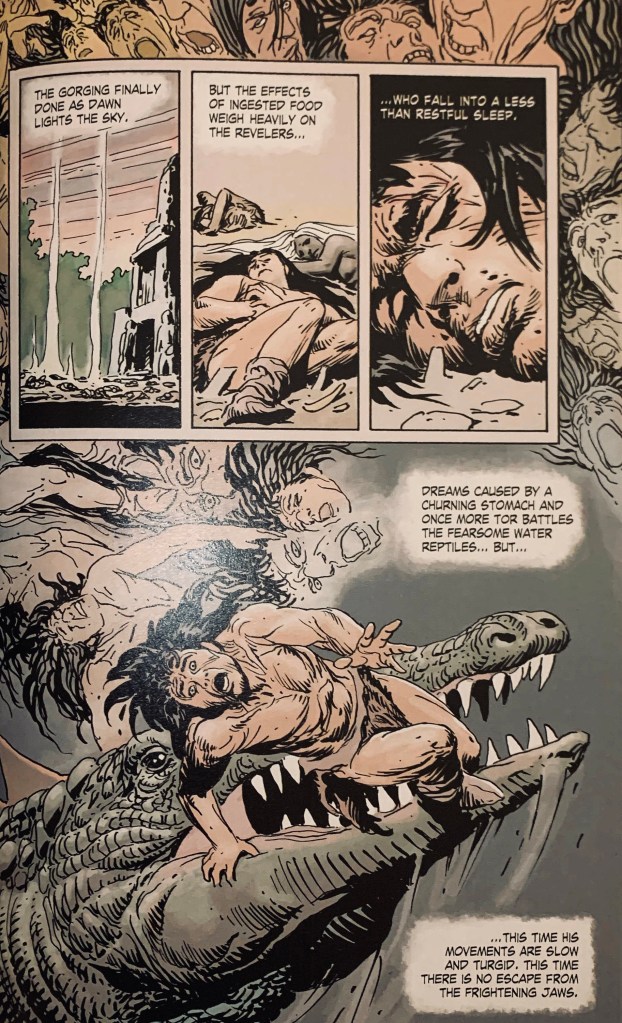
TOR – A Prehistoric Odyssey unleashes Joe’s paleo-chops. The panels are filled to the brim with not only Dinosaurs, but Sabre-tooth tigers, giant squids, prehistoric alligators, and yeti as well.
It’s been 6 years since Boxers and Saints was released, but it’s still an underrated set of graphic novels. Gene Luen Yang created an ambitious work, writing and drawing two separate graphic novels that tells both the Conservative Chinese and Christian/foreigner sides of the Boxer Rebellion.
Boxers and Saints acts as an excellent entry point for a time in history mostly unknown to non-Chinese Americans. Instead of picking up a doorstop tome on Chinese history, Gene Luen Yang shares the horrors and sadness of a story in a memorable form, leaving a kernel of curiosity for readers to explore further.
I’m only forty pages in and Gene Luen Yang isn’t bullshitting around. This is a brutal tale, and one that deserves more attention.
The discipline is to wake up in the morning, not turn on the machines you know just um… make some coffee and sit down and just draw whatever comes to your mind
Paul Pope shares how Lone Wolf and Cub brought the manga tradition of emphasizing character development over traditional three act plots.
Larry Hama explains how the fight scenes are depicted differently from their American counterparts. Lone Wolf and Cub uses cause and effect. A swing of the sword from character could be parried or missed by character B. This sequence would be reflected in the following panel.
Ronald Wimberly describes how mark making can communicate as its own language.
Both practices are rapid movements of the pen, marker or pencil, attempting to capture a form quickly.
A tag though is made to be seen. It’s intent is to pay homage to the creator.
Gesture drawing is an exercise. Their intent is to loosen up the artist, and then hit the wastebasket.
It is only action, the gesture, that you are trying to respond to here, not the details of the structure. You must discover – and feel – that the gesture is dynamic, moving, not static. Gesture has no precise edges, no exact shape, no jelled form. The forms are in the act of changing. Gesture is movement in space.
A reminder: Don’t fret. It’s fine to go through reams of paper:
Feel free to use a great deal of paper and do not ever worry about ‘spoiling’ it – that is one of our reasons for using cheap paper. I notice that students working at their best, thinking only of the gesture and not of making pictures, often throw their drawings into the trash-can without even looking at them. A few should be kept and dated as a record of your progress, but the rest may be tossed aside as carelessly as yesterday’s newspaper. Results are best when they come from the right kind of un-self-conscious effort.