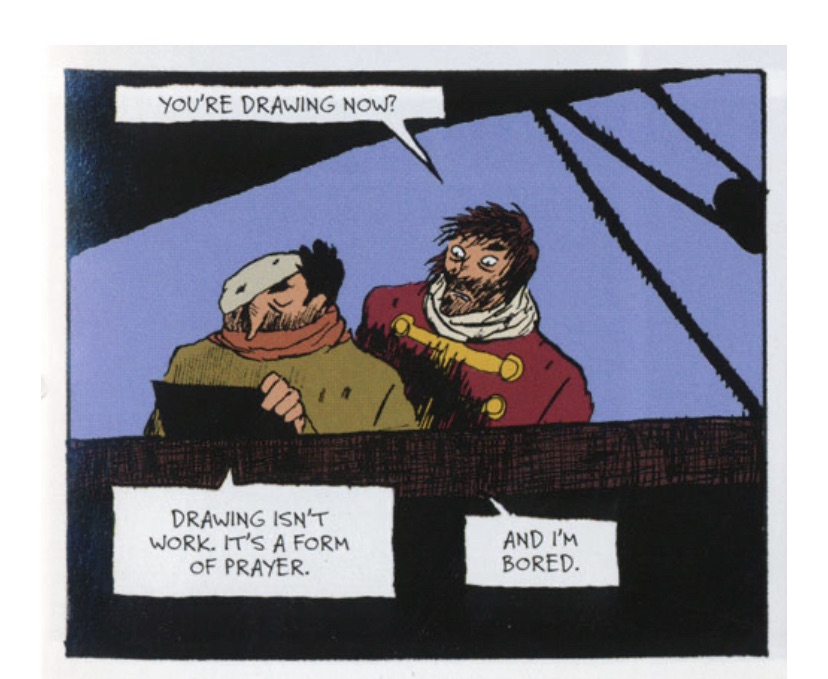
Work, to him, is a pleasure, and also a habit. When he moved into his flat on Powis Terrace in 1962, the largest room served as both his bedroom and his studio. On the chest of drawers, he place a notice in large capital letters reading ‘GET UP AND WORK IMMEDIATELY’ (which he did with all the more alacrity since he regretted wasting two hours painting the sign).
– Martin Gayford
One doesn’t need a separate room for a studio. You can make it work. Keep going.
Gayford, Martin, and Hockney, David. Spring Cannot Be Cancelled: David Hockney in Normandy. United Kingdom, Thames & Hudson, 2021. pp76
Each of these graphic media, he likes to say, sets its own technical tests for the artist. The Rapidograph required extreme concentration, because there was no possibility of erasure and correction. With charcoal, changes are much easier, but, he points out, you can’t put your hand on the drawing because it will smudge. Watercolour is equally unforgiving in another way: put too many layers on top of each other and it will go muddy. Conversely, each of these methods presents unique possibilities. The almost miraculous evocation of light, shadow, and reflection in those charcoal views of puddles and burgeoning vegetation along the East Yorkshire road called Woldgate could not have been achieved with a Rapidograph; nor could the Grecian elegance of his Rapidograph works have been accomplished with charcoal or crayon. He is a connoisseur of effects that can be obtained with various kinds of line, sometimes in unexpected places.
Martin Gayford
Add this to the what I wish I knew when I was younger list. Each type of graphic media has it’s strengths, and coupled with that, it’s drawbacks.
The key is knowing when which method is best to use.
Gayford, Martin, and Hockney, David. Spring Cannot Be Cancelled: David Hockney in Normandy. United Kingdom, Thames & Hudson, 2021. pp84
He has indeed made many different kinds of lines. An art historian could put together a chronology of his career just in terms of the multiplicity of diverse lines that he has produced. In the late 1960s and early 1970s, for example, there were the ultra-thin marks made by a kind of pen called a Rapidograph, with which he created drawings modelled with line alone — no shadows. Then, quite different, the works in coloured crayon and pencil of the early 1970s; the chunkier reed-pen strokes of portraits from the end of the decade, such as the poignant one of his mother done just after his father died in February 1979 ( not 1978, the date inscribed on the drawing); the later ones drawn with a brush, including watercolours from 2003; the extraordinary charcoal landscapes of the Arrival of Spring 2013; and on and on.
– Martin Gayford
A career life in lines sounds like a good one to aspire to.
Gayford, Martin, and Hockney, David. Spring Cannot Be Cancelled: David Hockney in Normandy. United Kingdom, Thames & Hudson, 2021. pp83
The trunk of an elephant might feel cool to the touch. Not what one expects, perhaps, from 200 pounds of writhing muscle, strong enough to uproot a tree, which tapers down to two “fingers,” giving it enough delicacy to detect the ripest berry on a shrub, and pluck it. Feeling an elephant’s trunk draws you to her other great feature: melancholic eyes that are veiled by long and dusty lashes. This combination of might with the suggestion of serene contemplation is surely the reason that elephants seem to embody a special state of grace.
I appreciate this description of an elephant’s trunk. It’s a surprising, captivating way to open a letter. Note the focus, the detail. Wang could have described the entire elephant, but instead he honed in on one appendage.
Good writing is specific.
Also, he recounts this admonition about learning he wrote in his 2017 letter.
“Knowledge can compound. I’d like for us to think more about how to accelerate the growth of learning. The traditional method of reading more books and trying to improve professionally are good starts, but it’s not enough to stop there. One can learn more by traveling to new places, being social in different ways, reading new types of books, changing jobs or professions, moving to a new place, by doing better and by doing more.”
– Dan Wang
Learning can compound.
Dan’s letters are beyond bookmarking. They are worth printing out and reading in hand.
This subterranean fire has its altar in each man’s breast, for in the coldest day, and on the bleakest hill, the traveller cherishes a warmer fire within the folds of his cloak than is kindled on any hearth. A healthy man, indeed, is the complement of the seasons.
Henry D. Thoreau
Thoreau, Henry D.. Essays: A Fully Annotated Edition. Italy, Yale University Press, 2013.
I happen to like drawing. I draw all the time. Wasn’t it Degas who said, I’m just a man who likes to draw.’ That’s me, I’m just a man who likes to draw. I think an awful lot of people like to draw. I’m always meeting people who draw a bit crudely, and I point out that what’s needed is a bit of practice. You need things pointed out to you: how to see in a clearer way. You can teach the craft; the poetry, you can’t teach.
David Hockney
The poetry comes from what you can’t draw. The lines you can’t make. The lines you wobble with.
Certainly, do all you can to master the craft, but your style will emerge from those wobbles…
Gayford, Martin, and Hockney, David. Spring Cannot Be Cancelled: David Hockney in Normandy. United Kingdom, Thames & Hudson, 2021. pp83
It’s true painting every day wouldn’t suit everybody, but it suits me. If you do that, you live in the now. Painters can live a long time. They either die young or make it to ripe old ages like Picasso, Matisse, Chagall, or my old friend Gillian Ayres. Do you know why? Because when you are painting, you’re so involved you can get out of yourself. Well, if you can do that, that’s added time. I am eighty-two and I feel fine. Maybe I walk slower.
– David Hockney
Hockney explains how when you age you notice more. I wonder if this applies to painters only. The narrative seems to be as you age, you notice less. You’re less alert. You care less. Maybe Hockney debunks those notions.
You notice more with each successive year; I am doing that now. I can go in and look at things more closely, such as a blossom. I took a branch and brought it in here to draw as a still life. It didn’t last long. I had to draw it in about four or five hours. It just rots when you bring it inside and lay it on a sheet of paper. It’s temporary, but most things are.
David Hockney
Gayford, Martin, and Hockney, David. Spring Cannot Be Cancelled: David Hockney in Normandy. United Kingdom, Thames & Hudson, 2021. pp205,207
‘All work made Jack.’ That witticism no doubt also contains a truth. Not much success is achieved without a lot of effort. But there is a catch. Csikszentmihalyi quotes a psychiatrist, an Austrian named Viktor Frankl: ‘Don’t aim at success – the more you aim at it and make it a target, the more you are going to miss it. For success, like happiness, cannot be pursued; it must ensue.’ That is to say, if you do something that you are fitted for, that you love and are good at, success may (or may not) follow. But if you do that, you have succeeded in the most important respects anyway.
On one hand, effort is required success. Hockney’s own life proves that “All work made Jack”. But it’s possible the results of our effort is out of our control:
Clearly, when Hockney as a teenager in Bradford spent all day drawing, then all evening too, he could not have expected wealth and fame to be the result. In early 1950s Britain, very few artists were even able to make a living from their work alone. He tells several stories about his surprise when he first discovered that people were willing to pay money for his pictures. He defined his own notion of a life lived without regrets to Kristy Lang, who interviewed him for The Times in the spring of 2020: ‘I can honestly say that, for the last 60 years, every day I’ve done what I want to do. Not many people can that. I’ve been a professional artist. I didn’t even teach much, just painted and drew every single day.
Spring Cannot Be Cancelled is a philosophy book wearing an art book mask.
Gayford, Martin, and Hockney, David. Spring Cannot Be Cancelled: David Hockney in Normandy. United Kingdom, Thames & Hudson, 2021. pp204
“Drawing is about two fundamental things,” I explained, my hand stabilizers compensating for the motion of the horse. “Use of shapes and use of shadows.” I did a quick sketch of her head, using broad, firm pencil strokes for the parts of the face. Some shading, a little more work on the eyes, and it started to pop. I’d always been good at faces; just don’t ask me do do hands.
”I’ve seen art before,” she said, curious. “But how do you make it seem so real?” “one of the tricks is something we call perspective,” I explained. “Some things are farther away, right? And some things closer? That goes for parts of a person too. On a face, some parts are close to you, other parts are farther away. The trick is to make it seem that way in a drawing.
”You can’t draw it like it’s flat. If I use shadows–and put the eyes on a curved line like this–and use just a touch of foreshortening. . .”
There’s a moment in drawing, at least for me, when a face transforms from shapes and lines into a person. The eyes were a big part, and the dots of light reflecting in them, but the lips were important too.
Was not expecting a flurry of drawing craft notes as we drive towards the conclusion of act three, but Brandon Sanderson…