Some people, when they have taken too much and have been driven beyond the point of endurance, simply crumble and give up. There are others, though they are not many, who will for some reason always be unconquerable. You meet them in time of war and also in time of peace. They have an indomitable spirit and nothing, neither pain nor threat of death, will cause them to give up.
Little Peter Wilson was one of these.
Dahl Roald. The Wonderful Story of Henry Sugar and Six More. New York: Viking, 1977.
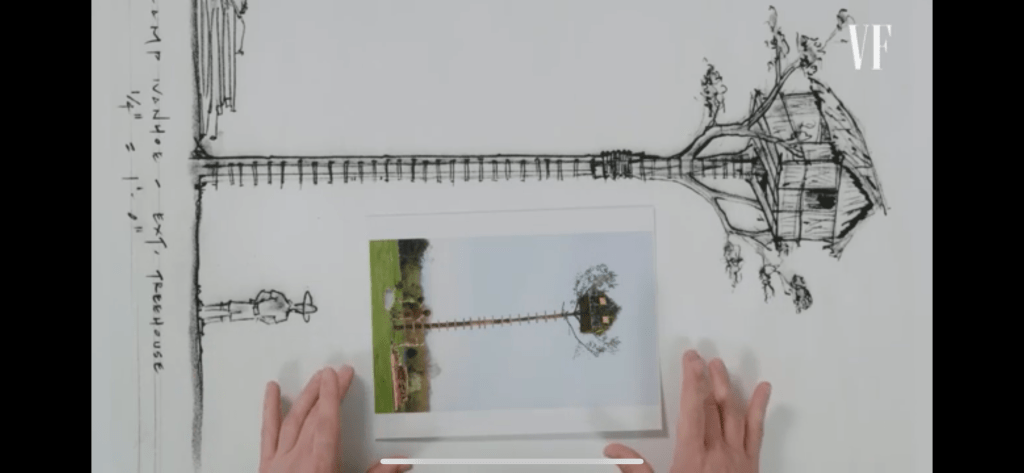
Wes looked at it and said, it’s just not extreme enough. You know, we want a tree house that’s dangerous. That’s the point of this, is that it’s just too much. We wanted to make the whole thing based on a telephone pole that was sunk into the ground. It had to be multiple trees tied together and that’s what you see here is, is one tree tied on to another.
When you’re talking about how we see these sets its really fun to be able to cheat massively, you know and to say well this is the tree house and it’s actually five foot, by four foot, by three foot, when you look at it from the outside. When you look at it from the inside its twenty feet wide and there’s sixteen kids having a conversation in there. There’s no augmentation to this at all. It’s exactly what you see here.
Herzog’s film school memories of a local family who took him in.
I loved the Franklins. With them, I got to know some of the best and deepest things about America. Later on, I invited them to Munich and took them to a party in Sachrang, the remote Bavarian village where I grew up. Hugs, beer, squeals. Contact became harder as much of the family, Billy included, seemed to fall further into religion. When I played the villain in a 2012 Hollywood action movie–it was called “Jack Reacher,” and the star, Tom Cruise, wanted me–the filming took place in Pittsburgh. But I couldn’t find the Franklins. I drove out to Fox Chapel. Almost everything in the area had changed; there were new buildings everywhere; it was depressing. The Franklins’ home was mostly unchanged; the lawn had the same old broad-leaved trees, but the path down to the garage was overgrown with flowering shrubs. There was no one home. I tried the neighbors, and learned that the house had changed owners several times. I knew that Evelyn Franklin had died. Two years later, I heard that Billy had died, too. He had been like a brother to me.
Herzog, Werner. (2023, August 21). The Mysteries of Pittsburgh. The New Yorker, 5–12. Retrieved from [https://www.newyorker.com/magazine/2023/08/28/the-mysteries-of-pittsburgh]
The best part of Werner Herzog is that you never know where he’ll appear – Mexico, Jack Reacher, The Mandalorian, Pittsburgh?
First Steven Spielberg, who is, if you make movies, if you direct movies, this is somebody who can help you. You look to his movie for solutions. He usually found a way to do it right. He’s one of my favorites.
But the steam car is now again on its way. The engine will probably be hermetically sealed, requiring no lubrication, no makeup water. Its condenser will operate with a vacuum. It will use diesel oil as fuel, and will cause very little pollution. It will be quiet, flexible, powerful. It will get off from a cold start in 30 seconds. It will contain so little water that the danger of explosion will be made negligible. It will have a fire, in a furnace instead of inside cylinders, but this will be so shielded, in the manner of a miner’s lamp, that it will not present a fire hazard in the garage. The engine itself will be so light that one mechanic can pick it up in his arms. It will last for years without attention. When in full production, it will be cheaper to build, and to operate, than present cars. The steam car will not be built by the present automobile industry unless some unit of that industry suddenly sees a great light, or public pressure or foreign imports force the decision, or government orders subsidize a new unit in the industry. It will have competition, as I will discuss later. But in fact, if I were disinterested, and had to bet, I might bet on steam.
I’m surprised Vannevar didn’t bring the steam car to market himself. He speaks of its components with such clarity. It’s like he’s reading off the cad files.
I wonder why the steam car idea never persisted? Why were battery powered cars realized instead? Will the steam car idea revive if the demand for batteries increases?
Bush, Vannevar. Pieces of the Action. San Francisco: Stripe Press, 2022. (see pgs. 229-230)
Tim Hunkin is a professional tinkerer. His YouTube videos series The Secret Life of Components are excellent primers to the hidden lives of machines – their components.
A few notes on chains:
For us engineering noobs, the chain is associated with the bicycle. But oh it’s so much more. Tim Hunkin demonstrates the variety of their uses. Old fashioned arcades. Pulleys. And even a giant metal clock.
Belleville washers are “dished” spring washers. They look a bit like Satellite dishes. These help with torque.
The advent of the “Bush” chain was revolutionary. Bush chains are the modern chain. Their pins are able to slot all the way through the bush. This allows the chain handle greater loads.
They were invented by Hans Renold who founded the Renold Chain Company in 1880. The Renold Chain Company is still in operation.
These pamphlets in Wes Anderson’s Criterion Collections are worth the price of admission. They’re filled with drawings, interviews, and behind- the-scenes insights. An analog version of a blu-ray’s bonus features.
Here Wes shares a glimpse of his process:
When I’m writing, I keep notebooks of my ideas for sets, props, and clothes. I incorporate some of these ideas into the script, but I set the majority of them aside to give privately to the different department heads during preproduction. In the past, I have occasionally forgotten some of my favorite ideas until it was too late – – for example, after the movie is out on video. To prevent this from happening on THE ROYAL TENENBAUMS (which contains more perhaps unnecessary visual detail than both my previous films combined), about three months before we started shooting, I asked my brother Eric, a skilled illustrator, to help me create a set of drawings that would include much of the information I wanted to communicate to the crew — and that would also suggest the overall look and feeling of the movie.
We had already found the house where I wanted to film (in the Hamilton Heights section of Harlem), and our production designer, David Wasco, had provided us with a set of blueprints, so I was able to very specifically plan the contents and arrangements of each of the rooms, and Eric was able to meticulously render them. Eric was, in fact, so meticulous that many of the sets had already been constructed by the time he finished the drawings. Eventually, however, his illustrations became the standard equipment on the walls of the production offices and art department and in the notebooks of everyone on the crew — a sort of manual to keep next to your script. We include a copy here for you.
— Wes Anderson
Criterion Collection Pamphlet. The Royal Tenenbaums
Is Wes Anderson the filmmaker with the highest percentage of his movies in the Criterion Collection? 9 from 10? I’m sure the French Dispatch is lurking at the door.
JEAN JULLIEN: Can you remember when I first started to draw?
SYLVIE JULLIEN: As far as I’m concerned, you’ve always drawn. You’ve been doing it ever since you were able to pick up a pencil. You didn’t “learn”
BRUNO JULLIEN: You drew all the time, even on tablecloths when we were out at restaurants. It was your way of expressing yourself, of describing the tiniest routine events. You did this in sketchbooks that you would carry around with you, the ones we would offer you regularly. It was a ritual.
JJ: Yes, you gave me my first sketchbook. When I was at school in Quimper (a city in northwest France), my teacher Jacques Vincent encouraged us to keep a journal. There wasn’t much in the way of rules; the idea was to get us to draw and draw and draw so that we developed a visual language. And what better way to do that than to look for inspiration in what is around you? I think that my practice of drawing every day and my interest in everyday life come from that exercise.
Jullien, Jean. Jean Jullien. New York: Phaidon Press Inc, 2022. (see page 35)
Having Jean Jullien’s parents share his drawing origin story is a wonderful approach. Our origin stories must look different to our parents, who if they were around, watched them manifest in real time.
The idea of keeping a drawing journal seems beneficial for developing your own visual language. Your own style.
Found this one late. Will add to the original list of seven.
The decay of the body is irreversible. Death is non-negotiable. After that, what’s left? Stories. But not just the stories as the story tellers remember them and then recounted them to others. The stories that people adapt from other people’s stories which then are retold, remade, and handed down until only their essence remains.
 Floodlights and Goalposts