How much time do you spend answering these questions? Thinking of a response? Researching for a factual (where necessary) response? Writing, editing and moulding the response? The fluidity of your responses seem like an almost spontaneous stream of consciousness, but the conciseness, the beauty, the lyricism, the depth of meaning and the way the response pulls together within its own universe belie a great deal of time. How long does it all take?
Great is liberty! Great is equality! I am their follower,
Helmsmen of nations, choose your craft....where you
     sail I sail,
Yours is the muscle of life or death....your is the perfect
     science....in you I have absolute faith.
I didn’t imagine Walt Whitman being an optimistic poet. The first few lines of Great Are the Myths is all Walt admiring people and ideas with intensity.
Don’t draw with cheap felt-tip pens. The ink in drawings made with felt tip pens will fade in a few years, and all you’ll be left with is a bunch of ghostly images, then nothing at all. And these drawings fade even faster when exposed to sunlight. So wise up and use pens with permanent ink, and try to draw on paper that’s not going to yellow and fall apart. (I learned this the hard way.)
Finish your work! Drawing complete stories is really hard, especially when you’re a kid, but there’s nothing like having a finished story-with beginning, middle, and end-to amuse yourself and your friends. Unfinished work just doesn’t cut it.
Save your stuff! Often, as your drawing and writing skills develop, or you get older and start having other more “mature” interests, your earlier cartoon work starts looking lame and clumsy. The usual urge is to toss it-but resist that urge! I guarantee that later in life you’ll be glad you held on to your cartoons, no matter how stupid they look now.
Don’t let your mom throw your cartoons out! Moms have a tendency to do this. You go off for a weekend visit to Aunt Gladys, or you get shipped off to summer camp, or you turn your back for a second, and poof! There go your toys, your comic books, and your brilliant artwork. And no amount of squealing is going to bring that stuff back. So take care of your treasures-keep ’em out of the way of anyone who has some weird hatred of “clutter” – and make sure everyone in your family knows you’re insanely possessive of your stupid, worthless junk. If you make your stand early, before permanent damage is done to your goodies, they may learn not to mess with your mess.
It’s okay to copy other cartoons, but it’s easy to get obsessed with a particular style that you can never master. I spent a solid year trying to draw Batman when I was eleven, and have nothing to show for it but a bunch of crummy-looking, vaguely Batmannish ghosts (see Item #1). So my advice is to copy from a whole bunch of different sources-eventually you’ll figure out a style that fits you.
Get a sketchbook. Do lots and lots of drawings. Fill up the sketchbook. Repeat.
Most how-to-cartoon books are terrible, so don’t get discouraged by their lousy advice. Remember, if the people who put together how-to-cartoon books knew what they were doing, they probably wouldn’t be doing how-to-cartoon books.
Check out the original artwork of cartoonists you admire. You may be in for a surprise. It doesn’t look as slick as the printed stuff, does it? It’s full of smudges, pencil marks, erased lines, and covered-up mistakes. Most young, would-be cartoonists end up getting totally bummed out because their stuff doesn’t look as slick and perfect as the stuff they see in print. But the original work by the pros themselves usually don’t look that good, either. So it’s okay for your original artwork to look a little smudgy, too.
It’s not horrible to be a crummy drawer. There’s room for all sorts of styles in the world. All I can draw are people with big eyeballs and no chins, and I can’t even do that well-but look at me. I get to blab about how to cartoon, and you get to listen to me.
And finally: Be original. It’s okay to copy the cartoons you love, if you must. But please: Eventually edge toward your own ideas and stories. That way I won’t have to track you down and sue you.
“You are writing, say, about a grizzly bear. No words are forthcoming. For six, seven, ten hours no words have been forthcoming. You are blocked, frustrated, in despair. You are nowhere, and that’s where you’ve been getting. What do you do? You write, ‘Dear Mother.’ And then you tell your mother about the block, the frustration, the ineptitude, the despair. You insist that you are not cut out to do this kind of work. You whine. You whisper. You outline your problem, and you mention that the bear has a fifty-five inch waist and a neck more than thirty inches around but could run nose-to-nose with Secretariat. You say the bear prefers to lie down and rest. The bear rests fourteen hours a day. And you go on like that as long as you can. And then you go back and delete the ‘Dear Mother’ and all the whimpering and whining, and just keep the bear.”
It may be a fancy word I want to remember, like say, pretentious. But fancy words are like my Air Jordan 11s – you pull them out only for special occasions.
After underlining a word, I make a silent promise to myself. I promise to return to the page. I promise to grab a real-life dictionary and look up the definition.
I break these promises to myself almost every time.
Tyler’s interviews have introduced me to disciplines I’d never consider exploring.
He speaks with urban planners, novelists, economists, tennis players, journalists, doctors – an incredible array of minds.
The final part of his interviews is called the Production Function. It’s where he asks his subject – What’s your productivity secret?
I found journalist Ross Douthat’s response helpful:
But there is a sense in which writing a column is — it’s like you’re a plumber. The toilet has to be fixed, so you fix the toilet. The column has to be written, so you write the column…
On approaching journalism with a tradesman’s mindset:
But journalism is a trade, right? I mean there is obviously an intellectual component. And we wouldn’t have been able to sit here and have this conversation with me babbling at you if I didn’t have intellectual pretensions. But the work of journalism — this is less true in the age of the internet — but it is linked to a very physical thing that comes out every week, or every month, or every day, and it comes out and it has to be filled.
And when there’s space to be filled, you write the column:
There is a place on the New York Times, on the printed New York Times, that would be blank or have an ad stuck on it if I didn’t write my column. And so you write the column. You write the column. And it’s useful for journalists to think about it this way — it’s useful for anyone inclined to over-romanticize or over-admire journalists to think about it this way.
On not sitting around waiting to become the next George R.R. Martin:
Certainly I like to imagine that — or at least something that sold as well as George R. R. Martin. But it also might be the case that if I had spent my life sitting around with my unfinished novels, I never would have produced anything interesting. And so it’s better to be a tradesman, and that’s at least part of how I think about my job.
There is something of the polar bear to Bjørnar: there in his powerful physique, his heftedness to the north, those white eyes, and of course in his name: Bjørnar, the Bear, from the Old Norse bjørn. He is an intense, intelligent presence; a person you would want fighting for you and would dread as an enemy. He is not without self-regard, but I do not begrudge him that.
There is also a strong mystical streak to Bjørnar: unexpected perhaps, in a man whose working life compels him daily to such pragmatism and self-reliance. But – as I will learn – Bjørnar looks often through things: hard into them and right through them with those pale eyes of his. He looks through people, through bullshit, and the through the surface of the sea.
Some mornings, in a perfect world, you might wake up, have a coffee, finish meditation, and say, “Okay, today I’m going into the shop to work on a lamp.” This idea comes to you, you can see it, but to accomplish it you need what I call a “setup.” For example, you may need a working shop or a working painting studio. You may need a working music studio. Or a computer room where you can write something. It’s crucial to have a setup, so that, at any given moment, when you get an idea, you have the place and tools to make it happen.
If you don’t have a setup, there are many times when you get the inspiration, the idea, but you have no tools, no place to put it together. And the idea just sits there and festers. Over time, it will go away. You didn’t fulfill it-and that’s just a heartache.
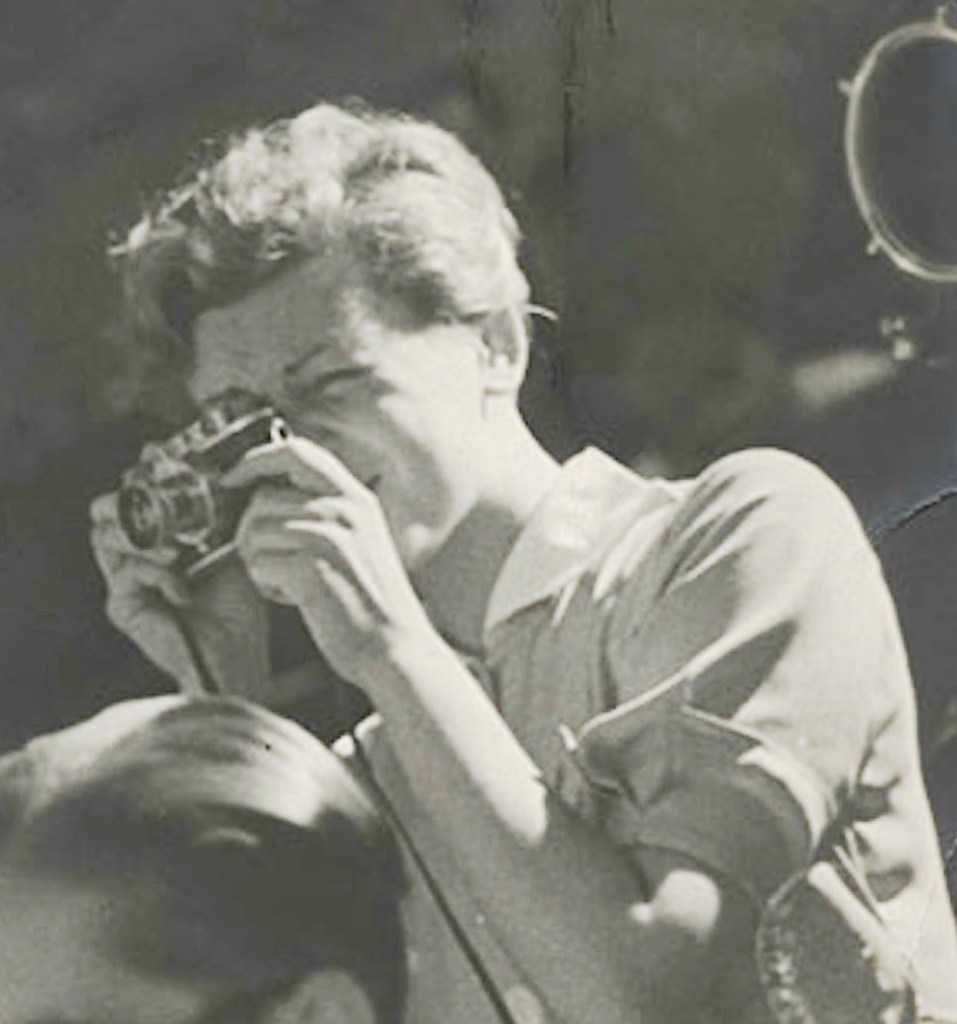
On the cover, Robert Capa was rockin’ a knit tie, Gerda a beret. I didn’t know who they were, but I knew they were special. I turned to chapter one and gave the first sentence a read:
As Robert Capa tells it: A metal ramp cranks open and lands with a splashing thud. Chilly dawn fog rushes into the craft where thirty soldiers sit shivering, crouched on benches. The floor sways, slick with vomit; the seas have been rough.
Reading that first sentence I realized, pictures of D-Day are so ubiquitous I never asked the question: Who took those photographs?
It’s easy to forget that amongst the soldiers, bullets, and death, were photographers like Robert Capa on the ground. Pioneers documenting war in a brave new way.
I’d never read about Robert or Gerda in a text book. Or heard their names in a history lecture. No mention of them in photography class. Hell, Amazon didn’t even list the book in my recommendations.
But Gerda’s story is irresistible, as Marc Aronson and Marina Budhos‘ book proves. The story is a mix of art, love, and living for something beyond yourself. Of stepping forward even when all is unknown. Gerda and Robert’s photography helped usher in a new form of journalism – photojournalism.
But before she became a pioneer, Gerda, then named Gerta Pohorylle, was a Jewish refugee struggling to adapt to life in Paris. Managing the demands of a starting a career. Navigating falling in love. And resisting the rise of fascism in Europe at that time.
For a brief while, she and Ruth roomed with Fred Stein and his wife, Liselotte, who had an enormous apartment with extra bedrooms. Fred had originally studied to be a lawyer in Berlin, but when he was unable to practice under Nazi law, he too picked up a camera and was making a go of it professionally.
What good parties they all had there – putting colored bulbs in the lamps, dancing! Fred snapped pictures of Gerta, mugging away. Yes, being poor, a stranger in a strange city, was awful, but to have the solace of friends, all in the same situation, made it easier. Maybe that’s why, as Ruth put it, “we were all of the Left.” That is, they belonged to a loose collection of groups opposed to fascism and in favor of workers’ rights.
Gerta was never exactly a joiner. Her sympathies, her ideas, came from her years in Leipzig. She hated the Nazis and knew how dangerous it was becoming for her family. But she wasn’t one of those who debated every political point. She wasn’t part of the Communist Party, which took its direction from the Soviet Union. But she did care about social issues, about the future ahead. They all did.
For now, there was food and coffee at the Café du Dôme and talk with friends. And photographs. Above all, photographs.
Eyes of the World is an underrated gem. A historic and important book that belongs on the shelf of every historian, photographer, professor, and curious and wonderful soul out there.


 Floodlights and Goalposts