When laid out this way, it would appear that the art of the sample, in the mind of Q-Tip, was science. He began by laying out pause tapes in his home until 1989, when he had the opportunity to be present for the recording of De La Soul’s iconic album Three Feet High and Rising. It was in those moments when he was shown around the studio by the in-house recording engineers and afterward was allowed to tinker with all the sampling devices. Seeing his potential and interest, the rapper and producer Large Professor taught him how to use other studio equipment to most effectively hone his sound. Not all young producers have a group of welcoming mentors like Q-Tip had, but not all young producers were as uniquely skilled from their teenage years as Q-tip was, and not all were as willing as Q-Tip to “dig deep in the crates” to search for sounds. Q-Tip was, in many ways, an extension of rap’s early DJs, chipping away at a massive block of music and peeling off only what he needed.
To release some of his jumpy energy and his mind’s ceaseless inventorying and inquisitiveness, Thurber drew. It was as habitual as his smoking. Writing-rewriting, as he often called it- required discipline, focus, research, an amped-up armature of full brain power that included memory, grammar, word and sentence sounds, a dialing in of the humorous of and the heartfelt, the meandering and the meaningful. But drawings? He considered his to be fluid, spontaneous, unhindered, and with rarely a need for erasure, revision, or polish. His daughter Rosemary remembers her father saying that he could even whistle while he drew.
A Mile and a Half of Lines: The Art of James Thurber, by Michael J. Rosen
If you’re looking for some artistic inspiration, or need to smile, pick up A Mile and a Half of Lines. After skimming through five or ten pages you’ll be feening to pick up a pencil and draw.
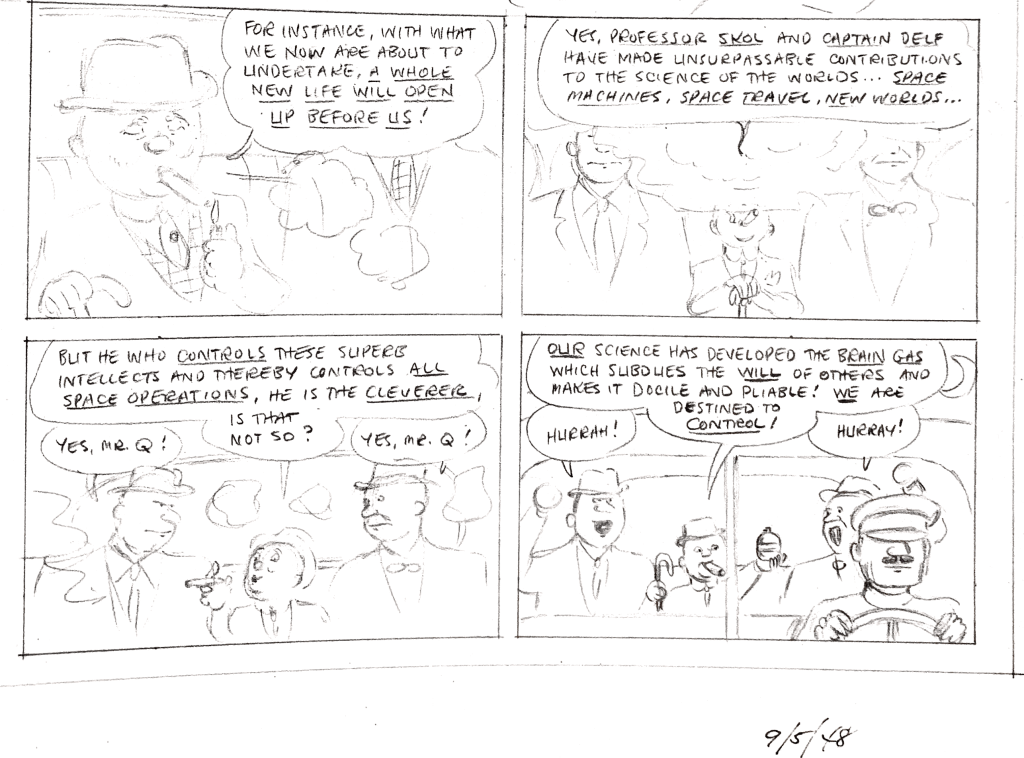
A Four Panel Friday first – layouts instead of completed work. This from an unpublished Spirit story titled: The Cigar.
Important note – Klaus Nordling drew these layouts, not Will Eisner.
Good example of solid panel framing here. Nordling goes from a relative close up of Mr. Q, to framing him between the two henchman. Sweet stache’ on the driver too.
January’s winds are merciless, splitting open dry knuckles with blood slivers. 9-to-5ers power-walk the final two blocks to their warm cubicles and electric standing desks.
A few trees down from the office, in-front of Heavy Burger, a strange collection of city trash lies. A toppled lime electric scooter, neck twisted, lays between the road and the side walk. An aluminum silver Baby Ruth candy bar wrapper flaps next to the handlebars. And a nylon purple poncho, a size 8 step away from the wrapper, collects rain in its creases.
A few years ago, economist Tyler Cowen published a complacency quiz to help individuals measure their level of complacency. The quiz has since been removed, but Tyler’s suggested complacency remedies are still posted.
He divided the remedies into three areas: Social Dynamism, Intellectual Dynamism and Physical Dynamism.
I’ve listed the suggestions I was most compelled to pursue. Read Tyler’s complete list here.
*Bonus: I created a few of my own remedies (see bottom). One for each of the three areas.
Can you invent a few?
Social Dynamism:
Go to lunch with someone in your office from a different department.
Explore a music genre you are not familiar with until you find three songs you really like.
Have a civil conversation with someone you typically disagree with on social or political issues. Take the time to figure out what drives them and where their ideas come from.
Intellectual Dynamism
Write an article defending the opposite political view of what you believe. Try to be as convincing as possible!
Identify the quirkiest thing about yourself and double down on that trait. Find similarly eccentric people in person or online.
Imagine your dream job. Look for it. Apply for it even if you think you aren’t qualified. What’s the worst that could happen?
Physical Dynamism
Leave your phone at home once a week.
Start a savings account so you can one day buy or rent the home of your dreams. Or at least have enough money to couch-surf all over the world.
Try to get to a location 20 or more min away (as the car drives) without your GPS.
*Bonus:
Social Dynamism – Attend a regularly scheduled religious service (e.g. Sunday morning, Saturday night) and sit in the first three rows of the sermon or lecture.
Intellectual Dynamism – Write a short story. 1,000 word minimum. Submit it to a literary journal or any another publication seeking short stories.
Physical Dynamism – Sign up to play at least one season of a recreational level sport. If you grew up playing team sports, pick an individual sport. If you grew up playing individual sports choose a team sport.
After two days of rain the sun is finally showing face. I drive pass the Radha Krishna temple, and the Montessori, hoping I’m not one of the last to arrive (first 22 play). Google maps? That rude bastard. He rides shotgun, but after every sub-division interrupts Andy Brassel’s commentary on Juventus’ historic 2003 semi-final win over Real Madrid.
I arrive on time, but as a group we’re late. Our back-up field is packed with weekend amateurs.
The diligent and disciplined have laid out their cones, set up their goals, and snatched up every free patch of turf.
We sit in the parking lot and argue which field we should play at now. From my car, I see heads nod. Some laughs are exchanged. Our Congress works like Washington’s – slow.
The majority come to an agreement and we drive back to the park we normally play at. The field waits for us, dotted with gulls spearing at worms in the wet soil.
A few of us run through some half-hearted old man stretches. Others chat about their midweek indoor matches. The fights that broke out. The incompetent referees. The games lost.
Savage Dragon was an idea from Erik Larsen’s youth that grew with him into adulthood.
Larsen’s Dragon cracked apart the general superhero story in two ways. (I’m sure there’s more than 2, but for now…)
Savage Dragon is a police officer. The typical super hero trope is a masked gymnast turned vigilante.
Chicago is Dragon’s home. Chicago isn’t as hipster cool as say, Des Moines, Iowa. But it also isn’t New York City, Metropolis, Gotham, Queens or any other NY alias that every other superhero pays crazy rent to live in.
One day early in Zidane’s first spell as Real Madrid manager, Casemiro knocked on his door. He hadn’t played yet — five games had passed — and he wasn’t happy. Play me, he said, please. Zidane looked at him, told him to calm down and said that once he started playing, he would never stop. Zidane was right, so much so that it became almost a running joke. After one game recently, Casemiro was asked if he was ever going to rest. By way of a response, he offered that cherubic smile he has and said something about how he didn’t need it. Zidane didn’t think so, either. You only ever leave Casemiro out to ensure that you can put him in.
the tactical beauty of having an omnipotent ball winner player such as Ndidi in your squad is that he allows you to shove an extra attacker onto the field without losing much (if any) defensive solidity.
Javier wasn’t even signed to be the big player he became – he made himself into that. He had an incredible professionalism and desire to make the very best out of himself. Whatever his coaches or fitness coaches wanted him to do, he was going to show he could do it.
You’re standing in one place, one patch of grass on a sunny Saturday afternoon in Seville, playing a game, which is to say doing your job, which is playing a game. A ball floats in the air toward you. You’re in one place and you’re in all possible places. Your name is stamped between your shoulder blades. You turn your back away from the ball. We all know who you are. You balance yourself and focus. What you’re about to do has no name.
From: They Think They Know You, Lionel Messi. By: Rowan Ricardo Phillips. The Paris Review, February 26 2019
I love finding pieces on footballers from outside of traditional football journalism. Especially when a masterful writer can share a new vision.
Rowan Ricardo Phillips accomplishes a rare feat with his Paris Review piece: They Think They Know You, Lionel Messi. He helps us relish, treasure again, this moment where we still have the opportunity to watch Lionel Messi at the peak of his powers.
Paglia: Like a medieval monk, I laboriously copied out passages that I admired from books and articles — I filled notebooks like that in college. And I made word lists to study later. Old-style bound dictionaries contained intricate etymologies that proved crucial to my mastery of English, one of the world’s richest languages.
I feel that the basis of my work is not only the care I take with writing, with my quality controls, my prose, but also my observation. It’s 24/7. I’m always observing. I don’t sit in a university. I never go to conferences. That is a terrible mistake. A conference is like overlaying the same insular ideology on top of it. I am always listening to conversations at the shopping mall.
COWEN: My last question before they get to ask you, but I know there are many people in this audience, or at least some, who are considering some kind of life or career in the world of ideas. If you were to offer them a piece of advice based on your years struggling with the infrastructure, and the number of chairs, and whatever else, what would that be?
PAGLIA: Get a job. Have a job. Again, that’s the real job. Every time you have frustrations with the real job, you say, “This is good.” This is good, because this is reality. This is reality as everybody lives it. This thing of withdrawing from the world to be a writer, I think, is a terrible mistake.
Number one thing is constantly observing. My whole life, I’m constantly jotting things down. Constantly. Just jot, jot, jot, jot. I’ll have an idea. I’m cooking, and I have an idea, “Whoa, whoa.” I have a lot of pieces of paper with tomato sauce on them or whatever. I transfer these to cards or I transfer them to notes.
I’m just constantly open. Everything’s on all the time. I never say, “This is important. This is not important.” That’s why I got into popular culture at a time when popular culture was — .
In fact, there’s absolutely no doubt that at Yale Graduate School, I lost huge credibility with the professors because of my endorsement of not only film but Hollywood. When Hollywood was considered crass entertainment and so on. Now, the media studies came in very strongly after that, although highly theoretical. Not the way I teach media studies.
I also believe in following your own instincts and intuition, like there’s something meaningful here. You don’t know what it is, but you just keep it on the back burner. That’s basically how I work is this, the constant observation. Also, I try to tell my students, they never get the message really, but what I try to say to them is nothing is boring. Nothing is boring. If you’re bored, you’re boring.