That from The Rest is History podcast, with Tom Holland and Dominic Sandbrook. The backstory here is young Churchill is traveling on a ship with a journalist from the Manchester Guardian. After spending a few days observing young Winnie this was his brilliant description.
Ambition combined with the ability to laugh at one’s self. Potent mix, that.
Listen to more exquisite Rest of History pods below:
What happened at the Battle of Ibera, a totemic though overlooked battle of the Punic Wars? With the forces of Carthage closing in on a depleted Rome, would a young Roman, Publius Cornelius Scipio resurrect the fortunes of the Republic? And, could he destroy Carthage’s most crucial power base in Europe?
Join Tom and Dominic, as they discuss this next phase of the Carthaginian Wars.
_______
To hear our previous series on the rise of Carthage, Hannibal, and the battle of Cannae, go to episodes: 421, 422, 423, 424, 568, 569, 570, 571.
_______
Join The Rest Is History Club: Unlock the full experience of the show – with exclusive bonus episodes, ad-free listening, early access to every series and live show tickets, a members-only newsletter, discounted books from the show, and access to our private Discord chatroom. Sign up directly at therestishistory.com
For more Goalhanger Podcasts, head to http://www.goalhanger.com
_______
Twitter:
@TheRestHistory
@holland_tom
@dcsandbrook
Video Editors: Jack Meek + Harry Swan
Social Producer: Harry Balden
Producers: Tabby Syrett & Aaliyah Akude
Executive Producer: Dom Johnson
Learn more about your ad choices. Visit podcastchoices.com/adchoices
Two solid paragraphs from Gordon S. Wood on Thomas Jefferson’s endless curiosity.
He was interested in more things and knew about more things than any other American. When he was abroad he traveled to more varied places in Europe than Adam’s ever did, and kept a detailed record of all that he had seen, especially of the many vineyards he visited.
Wood, Gordon S. Friends Divided: John Adams and Thomas Jefferson. New York: Penguin Press, 2017. pg. 10
Not sure how one measures that Jefferson was interested in more things, and knew more things than any other American, but I trust Mr. Wood here. Also, Jefferson’s record keeping is legendary.
He amassed nearly seven thousand books and consulted them constantly; he wanted both his library and his mind to embrace virtually all of human knowledge, and he came as close to that embrace as an eighteenth century American could. Every aspect of natural history and science fascinated him.
Wood, Gordon S. Friends Divided: John Adams and Thomas Jefferson. New York: Penguin Press, 2017. pg. 10, 11
It wasn’t enough that Thomas Jefferson owned seven thousand books. He consulted them regularly.
He knew about flowers, plants, birds, and animals, and he had a passion for all facets of agriculture. He had a fascination for meteorology, archaeology, and the origins of the American Indians. He loved mathematics and sought to apply mathematical principles to almost everything, from coinage and weights and measures to the frequency of rebellions and the length of people’s lives. He was an inveterate tinkerer and inventor and was constantly thinking of newer and better ways of doing things, whether it was plowing, the copying of handwriting, or measuring distances.
Wood, Gordon S. Friends Divided: John Adams and Thomas Jefferson. New York: Penguin Press, 2017. pg. 11
It’s hard to think of any modern, public person, with Jefferson’s insatiable appetite for “all of human knowledge”.
I have sketched my house at Easton Pierse and marked with a cross my grandfather’s chamber where I was born. If it had been my fate to be wealthy man I would have rebuilt my house in the grandest of styles. I would have added formal gardens in the Italian mode of the kind I have seen at Sir John Danvers’s house in Chelsea and at his house in Lavington. It was Sir John who first taught us in England the way of Italian gardens. I would have erected a fountain like the one that I saw in Mr Bushell’s grotto at Enstone: Neptune standing on a scallop shell, his trident aimed at a rotating duck, perpetually chased by a spaniel. I would have carved my initials on a low curved bridge across the stream. I would have remade my beloved home in the shape of the most beautiful houses and gardens I have visited in my unsettled life, tumbling up and down in the world. But fate has taken on a different path and the house of my dreams is mere fantasy: a pretty sketch on paper.
We should take these excerpts with some reservation. These aren’t John Aubrey’s copied diaries, but rather an original format historian Ruth Scurr uses to deploy John Aubrey’s biography.
John Aubrey is a man who knew what he wanted. We see this in the detailed descriptions of the gardens and fountains he dreamed of constructing:
I would have added formal gardens in the Italian mode of the kind I have seen at Sir John Danvers’s house in Chelsea and at his house in Lavington. It was Sir John who first taught us in England the way of Italian gardens. I would have erected a fountain like the one that I saw in Mr Bushell’s grotto at Enstone: Neptune standing on a scallop shell, his trident aimed at a rotating duck, perpetually chased by a spaniel. I would have carved my initials on a low curved bridge across the stream. I would have remade my beloved home in the shape of the most beautiful houses and gardens I have visited in my unsettled life, tumbling up and down in the world.
John Aubrey was a man who embraced his fate. He accepts his fate twice in one paragraph. This was probably a more common character trait in the 1600s. In the modern west we’re taught to battle against our fate. We’re told anything is possible. That if we’re passionate, put our minds to it, we can bend our fate to be anything – yeah, yada, yeah. So when you hear someone admit their fate was not to be a wealthy man, and they accept that, it catches the ear.
If it had been my fate to be wealthy man I would have rebuilt my house in the grandest of styles.
and
But fate has taken on a different path and the house of my dreams is mere fantasy: a pretty sketch on paper.
John Aubrey sketched! It’s not surprising. Photography was still two hundred years away, so people captured images by drawing. They preserved memories by drawing. They dreamed with their drawings:
I have sketched my house at Easton Pierse and marked with a cross my grandfather’s chamber where I was born.
and
But fate has taken on a different path and the house of my dreams is mere fantasy: a pretty sketch on paper.
The founding fathers had a general physician. His name? Benjamin Rush. The name sounded familiar, but truth is I knew nothing about him. But after an introduction from Brett McKay and Stephen Fried, I wasn’t surprised to learn he kept a commonplace book.
Brett McKay: Even the founding fathers did it. Something that really… You really hit home. And it really impressed me about Rush. Ever since he was a child, very curious, this self-starter, and something that he did that a lot of young upstarts did back in 17th century, 18th century, is he had a common place book and the guy just wrote down everything. How did that mental habit shape him for the rest of his life?
Stephen Fried: He did. And you know, what’s interesting, I found… I had the same question you had, and then I looked into it and I saw that even then there’s apparently a debate about how memory works. Of course, we’re still debating that, and the debate was, do you take notes and that makes you remember, or do you listen and not take notes, and that makes you remember? Most of Rush’s teachers thought you shouldn’t take notes, but Rush took notes. And so, what’s wonderful was after a certain point, we have them. I mean, a lot of things that Rush wrote are gone, I’m still hoping they will bubble up somewhere, but his commonplace books are wonderful. And part of the value of them is, of course, he did it when he was a kid, he did it when he was a student, and then when he was in the Continental Congress, he kept them about what it was like to be in the Continental Congress.
He would write little sketches about what he thought about the people in the Continental Congress, no holds bar. So he just… He wrote a lot, and so we have a lot of it, and we’re missing a lot of it, but everything we have is… What’s really nice about it also is that he wasn’t a formal writer. So he wrote in a style that we would today think of as almost like magazine writing. And it’s part of the reason that he was such an accessible intellectual and such an accessible writer is because, his writing style and of course, his penmanship were really readable, and when you read them today, they seem quite contemporary.
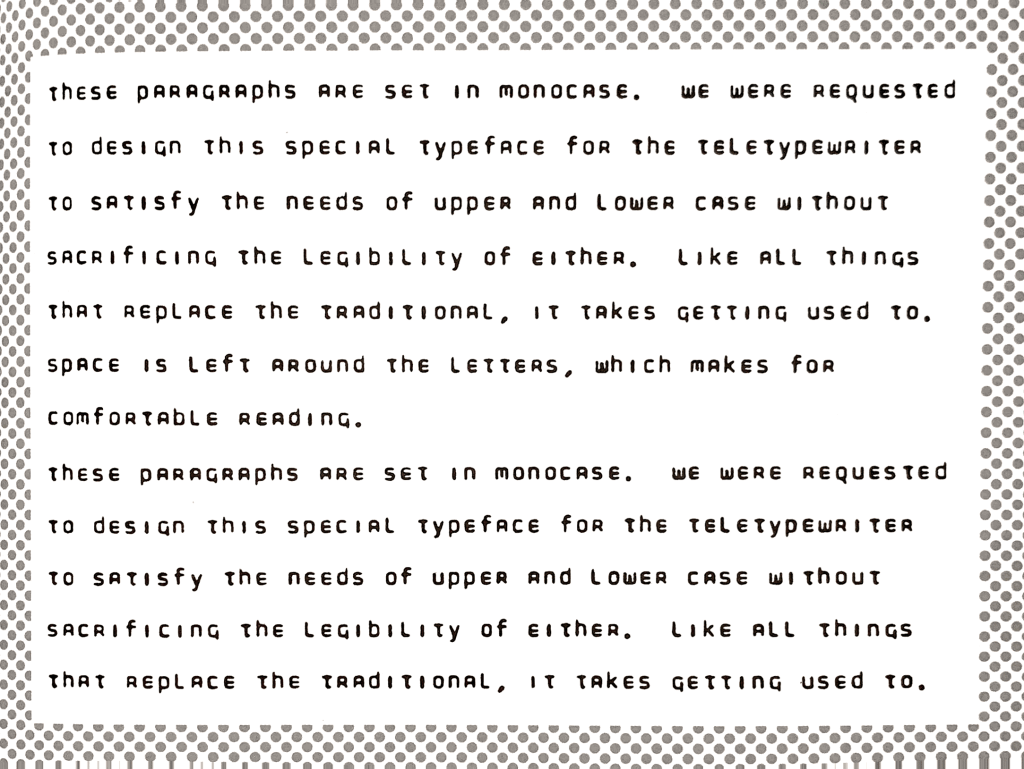
Doyald Young invented Teletype Monocase font in 1965.
Teletype was a precursor to SMS messages. A digital method for sending text between phone lines.
But there was one problem.
Teletype couldn’t handle upper or lower case letters.
Doyald Young was brought into to solve this problem. He was tasked with creating a font that would appear set in lower-case, but not offend its recipients when their proper names weren’t capitalized.
Alan admits, it’s OK not to read the great works everyday:
But you don’t read Shakespeare every single day and you certainly don’t read the tragedies every single day. Those are incredibly demanding for the same reason you don’t every night sit down and watch an Ingmar Bergman movie or 12 Years of Slave or something like that. You have to be able to give yourself a break from the demands of really great works of art.
Great works of art ask a lot of us and we’re kidding ourselves if we think we can rise to that occasion every single day. So, sometimes you ought to be reading Harry Potter instead of reading Shakespeare because you need a break. And I think both Bloom and Adler were reluctant to acknowledge that.
On seeing where your W-H-I-M takes you:
Yeah. So, I got this from the poet Randall Jarrell, who ended an essay that way, read at Whim. And Whim with capital W, W-H-I-M is a kind of a principle or a policy. Let me tell you how I came onto this. What would happen is that year after year after year, so I’ve been a college university teacher for 35 years now and I would have students who would come to my office and they would say, “I’m about to graduate, but there’s so many great things I haven’t read yet. Give me a list of things to read. Give me a list of books that every educated person should have read.” And they’re coming in with their notebooks and they’ve got their pins poised over the notebook. Like, “Give me these things.”
And I would think you’re just finishing up four years of school, give yourself a break. You don’t have to do this now. You don’t have to read according to an assignment or according to a list of approved texts. Enjoy your freedom. Go out there and follow your whim. And by that, I mean follow that which really draws your spirit and your soul and see where that takes you. If it turns out that you spend a year reading Stephen King novels or something like that, that’s totally fine. That’s not a problem. Read your Stephen King novels, but there are also really good novels.
But whatever it happens to be, if you’re reading young adult fiction for a year, read young adult fiction for a year. After a while, you probably got to have enough of that. But don’t go around making your reading life a kind of means of authenticating yourself as a serious person. It’s just no way to live. So, I would always tell them, “Give yourself a break. Don’t make a list. See where Whim takes you.”
How to read “upstream”:
Well, what happens is that there is a kind of an emergent structure in a way, things emerge. So, here’s one of the things that I will tell people. I’ll say, “Let’s say you really love Tolkien and you’ve read Lord of the Rings like 10 times and you’re not sure you want to read the Lord of the Rings again.” First of all, I will say, “Rereading is always a good idea. It’s always a good idea. But there may be times when you think, yeah, maybe I don’t need an 11th reading of the Lord of the Rings.”
And so, I’ll say, “Well then, let’s move upstream a little bit. Why don’t you ask yourself what did Tolkien read? What did he love? If you love Tolkien’s writing, what writing did Tolkien love and kind of go upstream of him and find out what he read.” And in that way, you’re doing something that is really substantial. I mean, learning about some new things, some important things, things that are really valuable, but you’re also kind of following whatever it is in your spirit that responded to Lord of the Rings. You’re taking it to that next level.
Yeah. So, I’ve done this before, this going upstream, but in a different way. So, my favorite novel of all time, I said this before on the podcast lots of times is Larry McMurtry’s Lonesome Dove.
Alan Jacobs:
Yeah.
Brett McKay:
And then I started reading his like … I’ve read that thing like five times, but then I was like, I’ve got to read the prequels. I started reading like a Dead Man’s Walk and a Comanche Moon. And then I started learning about that. I was like, “These Comanche Indians, I didn’t know about this.” And so, I was like, I went on Amazon and just searched books about Comanche Indians and that’s how I discovered Empire of the Summer Moon, fantastic book. It was some of the best books I’ve read.
Alan Jacobs:
Right. But you wouldn’t have discovered it if you hadn’t been actually reading at Whim. You were not thinking, “Oh, let me see, I’ve read this Larry McMurtry book, now I need to read all the other books that were well-reviewed that year.” Instead you were following up something that was really drawing you on. In a way, you’re just obeying your own curiosity and that’s a much better guide to reading than having a list that somebody else has given you.
And rereading a book can shake your core:
Brett McKay:
Well, what do you think the value of rereading is?
Alan Jacobs:
Well, there’s a lot. I mean, first of all, if it’s a really worthwhile book and books can be worthwhile in a thousand different ways, you’re never going to get everything important out of it on a first reading. But then in addition to that, you go through different stages of life. And in those different stages of life, books speak to you in dramatically different ways.
I remember once I used to teach Tolstoy’s Anna Karenina almost every year. And one year I was reading it and I came across a passage, which totally knocked me out and I couldn’t even remember having read it before. I’d taught the book six or seven times and I had completely passed over this particular passage. And it’s a passage where one of the two protagonists, a man named Konstantin Lëvin, his wife kitty has just given birth to their first child. And he picks up his newborn son and the first thing he thinks is, now the world has so many ways to hurt me. And it’s just an incredibly powerful scene.
Why didn’t I notice it before? Because I hadn’t had children before. It was as soon as my son was born, I saw that passage in a way that it would have been irrelevant to me before because it was so disconnected from my experience. At that point I thought to myself, what’s wrong with you that you didn’t notice this? Did you have to have a child in order to understand how emotionally overwhelming it is to have a child? I guess so. So, I learned something about myself there. I learned about the things that I was paying attention to and not paying attention to.
Read on a W-H-I-M.
Forge your own reading path. You don’t always need someone’s list to guide you.
The entire conversation will expand your mind, but I wanted to capture Adam’s suggestions for being a productive writer:
COWEN: You’ve written an enormous amount. Just this last week you had a major piece come out in the Guardian, one in London Review of Books. Your books are very long. What is your most unusual writing habit?
TOOZE: I’m not sure it’s unusual, but I think it’s the writing habit that many people have who do write a lot. I write every day, basically. I haven’t always found writing easy at all. I’ve been to a lot of therapy of various types to stabilize myself emotionally and psychologically. I still do. It’s very important for me in handling the stresses that arise in writing.
And one of the things I realized in the course of that is that, actually, rather than thinking it was something terrifying that I had to steel myself to do, the best way to think about it was as something I do every day, so it’s like exercise. If I have the chance, I like to exercise. It’s a puzzling activity. I just treat it almost as a game, rearranging the words, trying to fix things.
I’ll say to all of my grad students, you can do that for 10 minutes every single day, regardless of what else is going on in your life. You can always find that 10-minute slot. So that is the thing that I make sure I do. And that means even big projects slowly move along because then, when you get the big slice of time, the three or four hours at the weekend or something, it’s actually top of stack. You know where to go because you’ve been puzzling away at it and chewing on it every day, even if it’s only for 10 minutes.
COWEN: I give the exact same answer, by the way.
Not ground breaking advice by any means. But it applies well, specifically to editing.
10 minutes of edits a day and eventually you’ll have a finished piece.
Also, Adam’s suggestion for the best way to travel through Germany:
I would say travel. Get on the train. Unless you’re a car nut, and you want to experience the freedom of driving a Porsche at 200 miles an hour, which you can do if you do it at 2:00 am. The roads are clean enough, and they’re smooth enough.
But other than that, ride the train. Sit in an ICE going at, absolutely no kidding, 200 miles an hour, powered by solar power, and watch your coffee not even vibrate. It’s absolutely stunning. They have to put speedometers into the trains to make people aware of how fast they’re going.
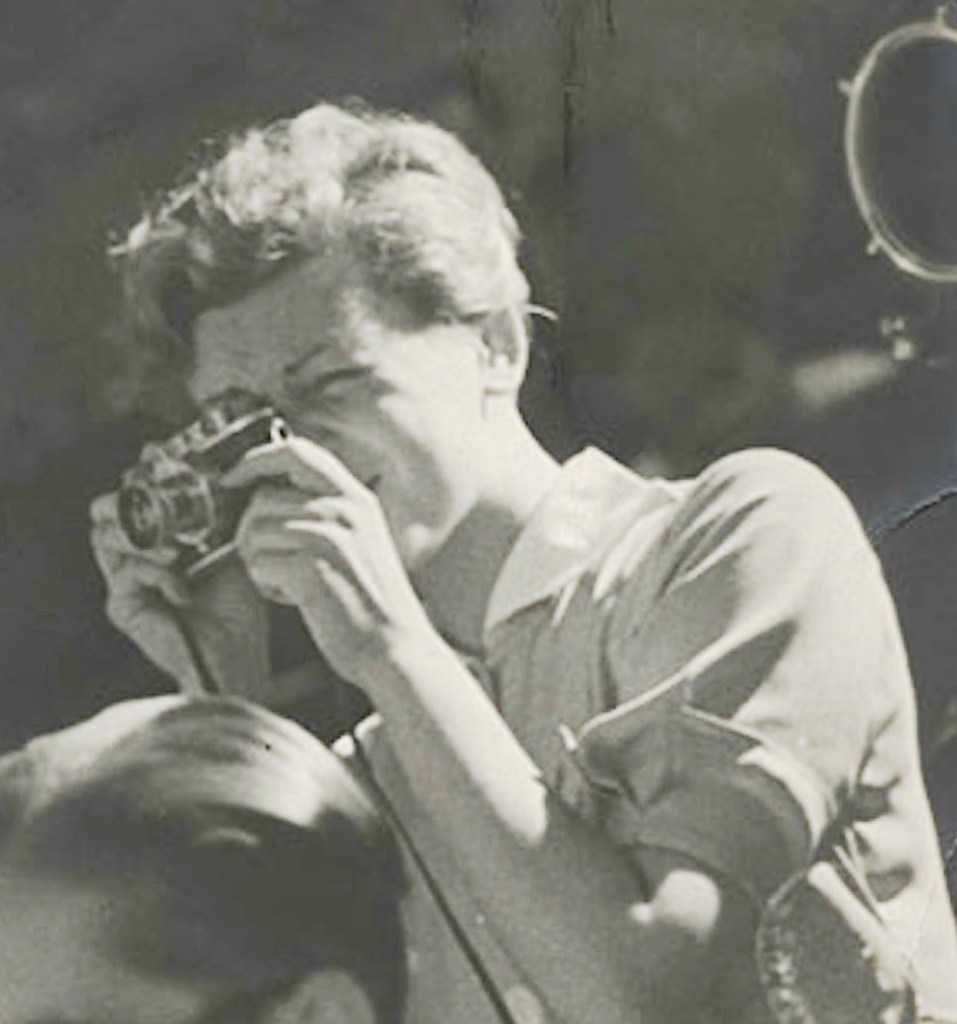
On the cover, Robert Capa was rockin’ a knit tie, Gerda a beret. I didn’t know who they were, but I knew they were special. I turned to chapter one and gave the first sentence a read:
As Robert Capa tells it: A metal ramp cranks open and lands with a splashing thud. Chilly dawn fog rushes into the craft where thirty soldiers sit shivering, crouched on benches. The floor sways, slick with vomit; the seas have been rough.
Reading that first sentence I realized, pictures of D-Day are so ubiquitous I never asked the question: Who took those photographs?
It’s easy to forget that amongst the soldiers, bullets, and death, were photographers like Robert Capa on the ground. Pioneers documenting war in a brave new way.
I’d never read about Robert or Gerda in a text book. Or heard their names in a history lecture. No mention of them in photography class. Hell, Amazon didn’t even list the book in my recommendations.
But Gerda’s story is irresistible, as Marc Aronson and Marina Budhos‘ book proves. The story is a mix of art, love, and living for something beyond yourself. Of stepping forward even when all is unknown. Gerda and Robert’s photography helped usher in a new form of journalism – photojournalism.
But before she became a pioneer, Gerda, then named Gerta Pohorylle, was a Jewish refugee struggling to adapt to life in Paris. Managing the demands of a starting a career. Navigating falling in love. And resisting the rise of fascism in Europe at that time.
For a brief while, she and Ruth roomed with Fred Stein and his wife, Liselotte, who had an enormous apartment with extra bedrooms. Fred had originally studied to be a lawyer in Berlin, but when he was unable to practice under Nazi law, he too picked up a camera and was making a go of it professionally.
What good parties they all had there – putting colored bulbs in the lamps, dancing! Fred snapped pictures of Gerta, mugging away. Yes, being poor, a stranger in a strange city, was awful, but to have the solace of friends, all in the same situation, made it easier. Maybe that’s why, as Ruth put it, “we were all of the Left.” That is, they belonged to a loose collection of groups opposed to fascism and in favor of workers’ rights.
Gerta was never exactly a joiner. Her sympathies, her ideas, came from her years in Leipzig. She hated the Nazis and knew how dangerous it was becoming for her family. But she wasn’t one of those who debated every political point. She wasn’t part of the Communist Party, which took its direction from the Soviet Union. But she did care about social issues, about the future ahead. They all did.
For now, there was food and coffee at the Café du Dôme and talk with friends. And photographs. Above all, photographs.
Eyes of the World is an underrated gem. A historic and important book that belongs on the shelf of every historian, photographer, professor, and curious and wonderful soul out there.



 Floodlights and Goalposts